From biology to brown stink bug control - Euschistus heros
By Vanessa Exteckoetter; Karolina Gomes de Figueiredo; Geísy Nascimento Leal; Mariana de Souza Gonzaga; and Nathan Jhon Lopes, Federal University of Lavras
The 2023/2024 harvest has been facing several challenging scenarios in Brazil. This is largely due to the climatic characteristics that the year imposed on the entire agribusiness production chain. In fact, until last harvest (2022/2023), farmers in southern Brazil had been facing severe water shortages. However, for this harvest, the effect caused by “El Niño” brought with it a large volume of rain in the months of September to November in the South of Brazil, while the northern half of the country suffered from water scarcity. These extreme climate variations cause significant impacts on production systems and consequently on the population dynamics of insect pests. This is the case with caterpillars. Currently, we have noticed an increase in the frequency of caterpillar outbreaks in soybean crops, with reports of densities above ten caterpillars per m² in Mato Grosso, Paraná and Rio Grande do Sul. Compared to previous harvests, the population density of caterpillars in areas of soybeans are significantly higher.
There are several reasons for the occurrence of a population outbreak of a specific pest, however, considering the diversity of production environments and the similarity of the occurring species, we sought to list some factors that are common. Initially, we noticed that in the south of Brazil, we had a relatively warm winter, with minimum temperatures above climatological normals. This allowed the survival of most insect pest species (even at low density) on host plants or alternatives during the off-season. During the beginning of the development of soybean cultivation, there was a high frequency of precipitation, a factor that made phytosanitary management operations difficult on a large number of agricultural properties. Therefore, the population of caterpillars present since the off-season has increased significantly.
In the case of the Central-West, water scarcity made it significantly difficult to sow within the ideal windows. Due to this mismatch in sowing, there was a large occurrence of nearby areas with drastically different phenological stages. In these scenarios, older areas tend to serve as sinks for insect pests for younger areas. In general, due to water scarcity, phytosanitary management could not be used effectively, either due to financial frustration due to uneven sowing, or due to weather conditions not being ideal for the operation. Therefore, situations like the current ones favor the occurrence of population outbreaks, not only of caterpillars, but of most insect pests of soybean crops.
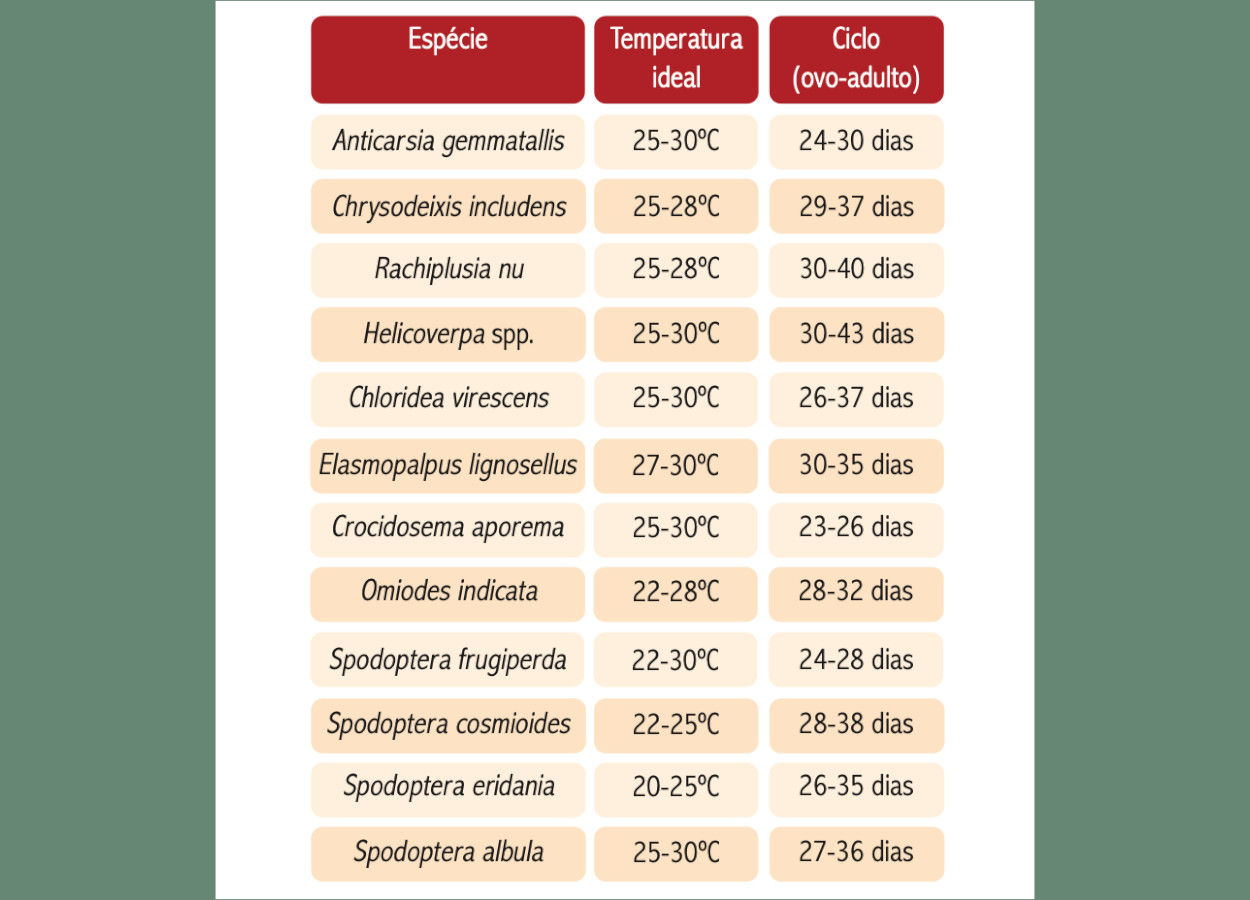
More specifically, we draw attention to the importance of temperature on the occurrence of outbreaks. This variable is a limiting factor for the development of insects. Environments with higher temperatures provide a greater rate of reproduction and speed of development, leading to the occurrence of population outbreaks. Among the main species of caterpillars associated with soybean cultivation are: Anticarsia gemmatallis, Chrysodeixis includens, Rachiplusia nu, helicoverpa spp., Chloridea virescens, Elasmopalpus lignosellus, Epinotia aporema, Omyodes indicata and the complex spodoptera (Spodoptera frugiperda, S. cosmioides, S. eridania e S. albula). Through Table 1 it is possible to verify the ideal temperature ranges and their respective approximate egg-adult cycles for each of these species. We highlight that these temperature ranges are considered ideal for the development of these species, but are not considered limiting, that is, they may occur at temperatures outside the indicated ranges.
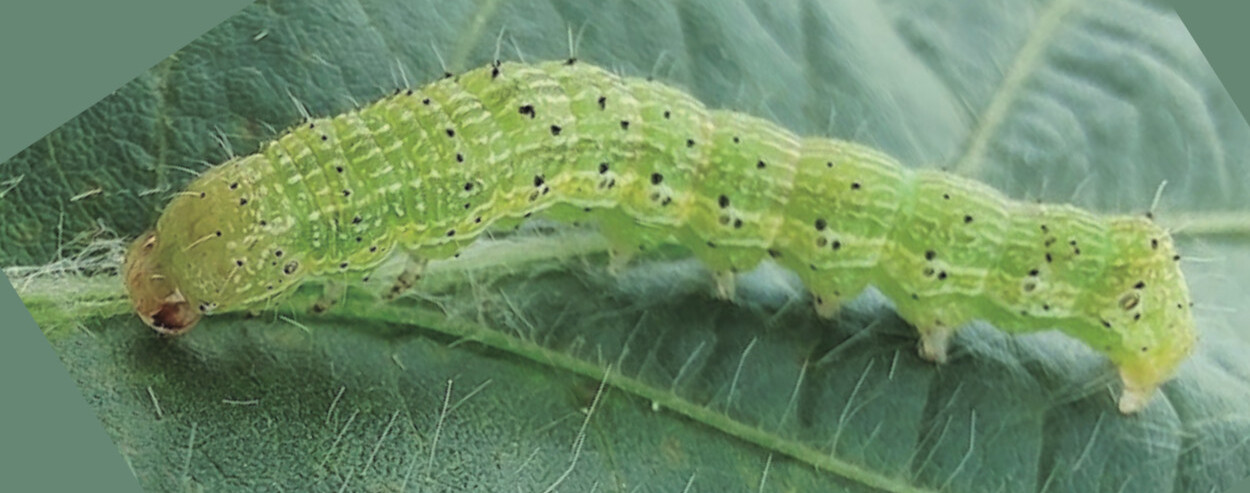
In the current harvest, among the species mentioned, we noticed a greater occurrence of the complex spodoptera (Figure 1) in different regions of Brazil, and at different phenological stages of soybean cultivation. As mentioned previously, high temperatures, disparity between phenological stages in nearby areas, operational difficulties in control, in addition to the presence of green bridges, provide recurrent population outbreaks. Therefore, during this harvest it is common to observe caterpillars causing damage related to the plant stand, leaf area, flowers and pods.
In terms of management, we highlight that the main control tool continues to be intensive monitoring. Through it, it is possible to detect the beginning of infestations, as well as the development phase of each species. In this way, decision-making for control and choosing the appropriate tool is based on data. We cite an example of variation in the control of caterpillars of the species Spodoptera frugiperda depending on its size (Figure 2). We also highlight the importance of appropriate tools regarding application technology, the addition of spreading adjuvants, adhesives, surfactants, as well as essential oils with insecticidal activity that are compatible with active ingredients and add control efficacy.
Therefore, this harvest is being marked by different, but related, challenges. Therefore, monitoring and understanding the complexity of the production system allows us to design management strategies and implement control tactics more assertively.
By Eduardo Engel, Daniele Caroline Hörz (Esalq/USP); Thomas Eliel Hörz, Maisa Jungbeck, Leonardo Wallauer Van Ass (Next Agrociência LTDA); Marcelo Zakseski (Agronomic Knowledge)
Article published in issue 296 of Cultivar Grandes Culturas Magazine
Receive the latest agriculture news by email