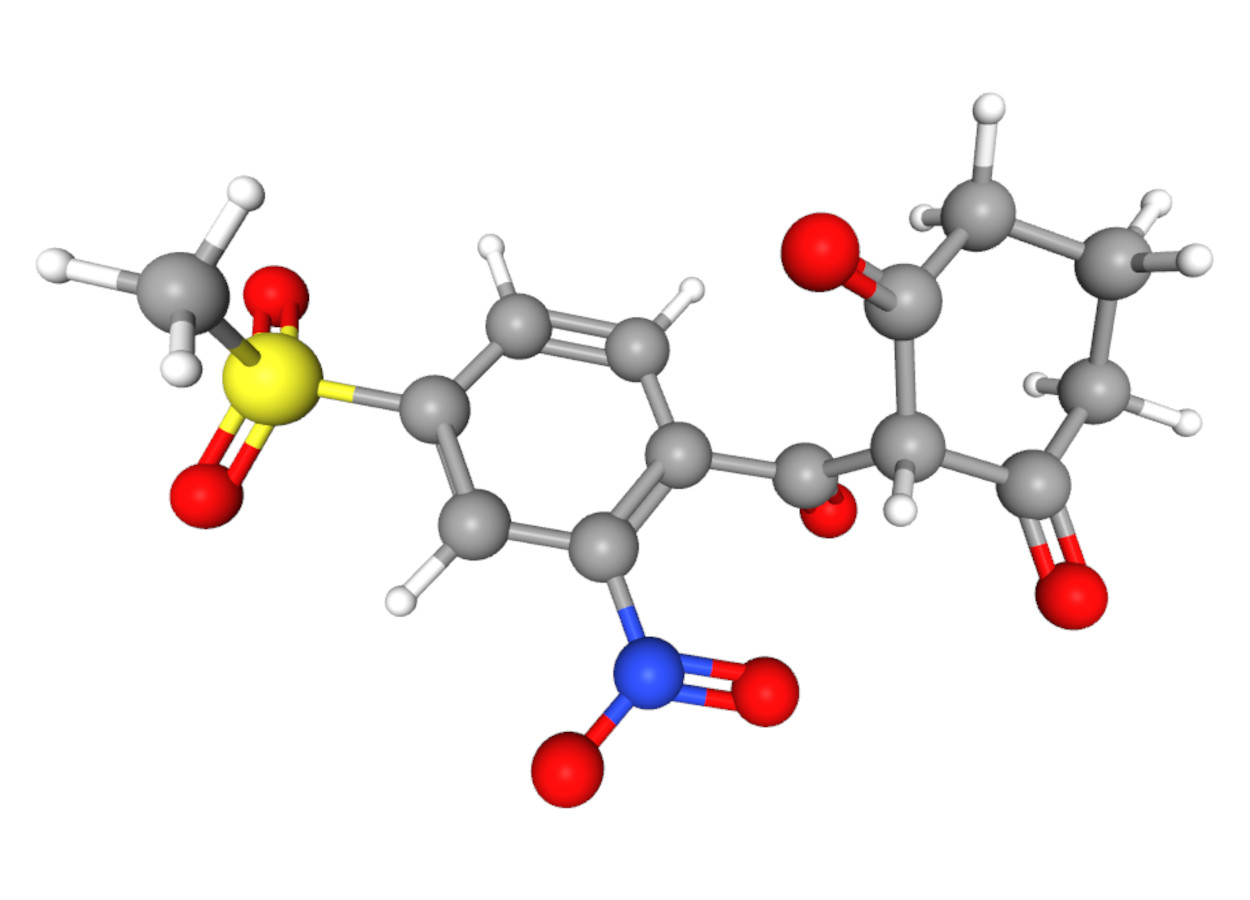
Mesotrione is a selective herbicide widely used in agriculture, especially in corn crops, for the control of broadleaf weeds.
Common name (ISO): Mesotrione
Synonyms: ZA1296 (development code); Callisto (commercial product)
Gross formula: C14H13NO7S
Number CAS: 104206-82-8
Chemical class: The herbicide triketone (or aroylcyclohexanedione) belongs to the HPPD (4-hydroxyphenylpyruvate dioxygenase) inhibitor family.
Release year: 2001
Development history: The development of mesotrione was inspired by the natural substance leptospermone, found in the tree. Callistemon citrinusIn the mid-1970s, a researcher observed the absence of weeds under this tree in his backyard, which led to investigations into its allelopathic effect. In 1977, chemists at Stauffer Chemical Company isolated leptospermone and identified its biological activity as an HPPD inhibitor. Stauffer was acquired by ICI in 1987, which continued work on synthetic analogs, resulting in compounds such as sulcotrione and, finally, mesotrione. Zeneca Agrochemicals (ICI's successor) selected mesotrione (code ZA1296) for development due to its effectiveness against broadleaf weeds and selectivity in corn (due to rapid metabolization by the plant).
Mode of action: Mesotrione acts as a selective inhibitor of the enzyme 4-hydroxyphenylpyruvate dioxygenase (HPPD), essential in the biosynthesis of carotenoids, tocopherols, and plastoquinone. Its potency is high (Ki ≈ 10 pM in Arabidopsis thalianaBy blocking this pathway, it causes leaf bleaching (chlorosis), chlorophyll degradation, and weed death within 1-3 weeks. It is absorbed by the roots and leaves, with systemic translocation. It is selective because crops like maize metabolize it rapidly via cytochrome P450.
Patent numbers: US$5,006,158; US$4,997,473 and others.
Other information:
Palmer's amaranth (Amaranthus palmeri), considered the most prolific and problematic weed in North America, has developed resistance to several herbicide mechanisms of action. Repeated use of any herbicide, especially at doses lower than recommended, can lead to the development of resistance in weeds, and therefore, a better understanding of the resistance evolution process is essential for the management of palmer's amaranth and other difficult-to-control weed species. Palmer's amaranth has rapidly developed resistance to 4-hydroxyphenylpyruvate dioxygenase (HPPD) inhibitors, such as mesotrione. The aim of this study was to test the potential of low-dose mesotrione applications to select plants with lower susceptibility over multiple generations in a palmer's amaranth population collected from an agricultural area in 2001. F0 plants from the population were initially treated with sublethal doses of mesotrione and evaluated for survival three weeks after treatment. All F0 plants were controlled at a dose of 1× (x = 105 g ai/ha). However, 2,5% of the F0 plants survived the 0,5× treatment. The recurrent selection process, using plants that survived different doses of mesotrione, was continued until the F4 generation was reached. Based on GR50 values, the sensitivity index was determined to be 1,7 for the F4 generation. Compared to F0, the expression level of the HPPD gene in the F3 population increased. The results indicate that, after several rounds of recurrent selection, successive generations of Amaranthus palmeri became less responsive to mesotrione, which may explain the lower sensitivity of this weed to HPPD inhibitor herbicides. The results are significant considering recently released soybean varieties and soon-to-be-released cotton varieties resistant to HPPD inhibitors. - DOI 10.3390/plants10071293 -
Cultivar Newsletter
Receive the latest agriculture news by email