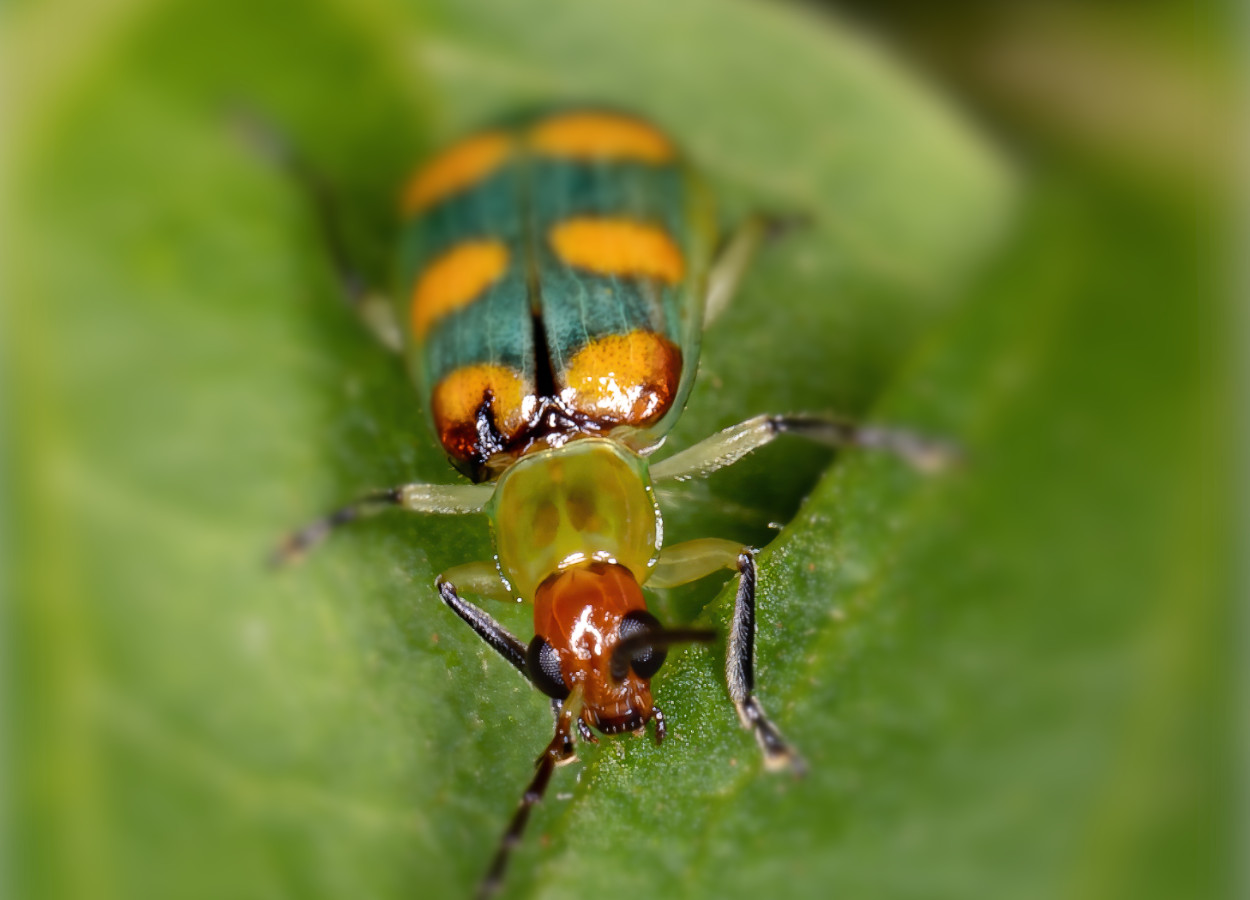
Diabrotica speciosa (Germar, 1824), known as the cowweed beetle, Brazilian beetle, or patriot beetle in its adult stage and as pinworm larva in its larval stage, is one of the most agriculturally important chrysomelid beetles in South America. It causes damage to corn, potatoes, beans, soybeans, peanuts, and various vegetables, both through larval feeding in the soil and adult feeding in the aerial parts of the plant.
Taxonomy and identification
Diabrotica speciosa belongs to the order Coleoptera, family Chrysomelidae, subfamily Galerucinae, tribe Luperini, subtribe Diabroticina. The parentheses in the authorship indicate that the species was originally described in another genus. The subspecies Diabrotica speciosa speciosa and Diabrotica speciosa vigens are recognized (Cabrera Walsh et al., 2020).
The genus Diabrotica comprises over 400 described species, mostly Neotropical. Traditionally, it is divided into the groups virgifera, fucata, and signifera, although studies with South American species indicate less clear boundaries than previously thought. Diabrotica speciosa belongs to the fucata group, whose studied species are polyphagous as larvae and adults, multivoltine, and overwinter in the adult stage. This distinguishes it from species in the virgifera group, such as Diabrotica virgifera virgifera, which are univoltine and survive the winter as diapause eggs (Cabrera Walsh et al., 2020).
The adult measures approximately 5 to 7 mm and has a general green coloration, with three transverse-oval yellow spots on each elytron. The head is reddish-brown, the antennae are dark and filiform, with 11 segments, and the tibiae are black (Ávila & Milanez, 2004; Viana, 2010). It differs from *Diabrotica viridula*, which also occurs in corn in Brazil, by its smooth elytra and reddish-brown head; in *Diabrotica viridula*, the elytra have ribs and the head is green. In sexing, the antennae of males (approximately 5 mm) are longer than those of females (approximately 4 mm) (Ávila & Milanez, 2004).
Biology and life cycle
Diabrotica speciosa is holometabolous, and the duration of each stage depends strongly on temperature. For the egg, the base temperature is 11,1 °C and the thermal constant is 119,1 degree-days; the embryonic period drops from 19,6 days at 18 °C to 5,7 days at 32 °C (Milanez & Parra, 2000a). The larva-adult period varies from about 25 days in maize seedlings to 36,5 days in the least favorable host (Ávila & Parra, 2002). With the estimated thermal constant for the egg-adult cycle at about 475 degree-days, the complete cycle takes approximately 35 days at 25 °C and 26 days at 30 °C (Milanez, 1995, cited by Laumann et al., 2003).
Females lay their eggs in the soil, near the base of plants, and prefer dark, moist soils rich in organic matter (Milanez & Parra, 2000b). The eggs are yellowish and measure approximately 0,65 × 0,36 mm (Ávila & Milanez, 2004). Fecundity depends on the adult's food and temperature: females fed bean leaves laid about 800 eggs at 20 and 25 °C, but about 300 at 30 °C (Ávila & Parra, 2001). With soybean or forage turnip leaves, the laying rate was between 225 and 325 eggs, and with corn or wheat leaves it was practically zero (Bitencourt & Ávila).
The larval stage has three instars and is subterranean. The larvae are whitish, with a dark head and anal plate, and reach about 10 mm in length (Viana, 2010). They feed on roots and, in potatoes, they bore into the tubers, producing the small holes that gave rise to the name "pinworm larva". The pupa forms in a chamber in the soil.
Adults are diurnal and polyphagous. They eat mainly leaves, but also flowers, stigmas and fruits, and prefer bean and soybean leaves to corn and rice leaves (Marques et al., 1999). Longevity varies with temperature: it exceeded 100 days at 20 °C, was between 44 and 57 days at 25 °C and did not reach 21 days at 30 °C, with adults fed on beans (Ávila & Parra, 2001).
There is no egg diapause. In populations from cooler temperate and subtropical areas, there is evidence of reproductive diapause in adults during winter (Cabrera Walsh et al., 2020). In the field, generations are continuous and overlapping. In Argentina, adult emergence occurred with weekly averages above 13 °C, which corresponds to about three generations per year in temperate areas and at least five in subtropical areas (Cabrera Walsh et al., 2013).
Distribution, hosts and natural enemies
Diabrotica speciosa occurs throughout South America, except in Chile, from the Patagonian steppe to the tropics and above 2.500 m altitude (Cabrera Walsh et al., 2020). In Brazil, it has been recorded in practically all states. EPPO has maintained it on the A1 list of absent quarantine pests since 2002.
Adults have more than 132 recorded hosts in 24 botanical families. Larvae have at least five confirmed hosts in the field: corn, wheat, sorghum halepense, peanut, and potato; other species, such as soybean, have supported development in the laboratory (Cabrera Walsh, 2003; Cabrera Walsh et al., 2020). Corn is the best food for the larvae, and the common bean is the most suitable for the adults (Ávila et al., 2019).
Two adult parasitoids are known: Celatoria bosqi (Diptera: Tachinidae) and Centistes gasseni (Hymenoptera: Braconidae). Natural parasitism generally ranges between 1% and 28% and is highest at the end of the growing season, when most of the damage has already occurred. There are at least ten generalist predators recorded for adults, but no predators or parasitoids of larvae have been documented in South America (Cabrera Walsh et al., 2020).
Damage and economic importance
In corn, the larvae destroy the roots and reduce anchorage, leading to lodging and curvature of the stem base known as "goose neck." In young plants, there was a reduction in root and shoot dry mass and height from the lowest densities tested, and the control level was estimated below 40 larvae per plant (Marques et al., 1999). The actual crop loss is still poorly quantified, partly because the damage is indistinguishable from that caused by Diabrotica viridula (Cabrera Walsh et al., 2020).
In potatoes, larvae and adults cause damage, and the perforations depreciate the tubers; in Brazil, producers consider the species the main pest of the crop. Adults defoliate seedlings of soybeans, beans, cotton, sunflowers, tobacco, and other crops, and also attack flowers and fruits, such as table grapes (Cabrera Walsh et al., 2020). Adults also act as vectors of comoviruses, including the bean rough mosaic virus and the cowpea severe mosaic virus (EPPO).
Integrated management
The absence of diapause in the eggs, continuous generations, and polyphagy of the larvae reduce the effectiveness of crop rotation, unlike what occurs with Diabrotica virgifera virgifera. In temperate regions, early sowing of corn can cause the first generations of larvae to find more developed and less susceptible plants (Cabrera Walsh et al., 2013).
Corn with the Cry3Bb1 protein has been available in Brazil and Argentina since 2010 and, in the field, has kept root damage below the economic level (Cabrera Walsh et al., 2020). Landrace corn varieties with antibiosis or tolerance to larvae, such as Pérola, Palha Roxa, and Azteca, are sources for breeding (Costa et al., 2018; Costa et al., 2021).
In Brazil, there are a large number of insecticides registered for *Diabrotica speciosa* in corn, potatoes, and beans, and the updated list should be consulted on Agrofit. For larvae in corn, seed treatment has been reported as inefficient, and liquid applications in the sowing furrow have yielded better results; in potatoes, neonicotinoids stand out (Cabrera Walsh et al., 2020). The growth regulator lufenuron reduced the fecundity and viability of eggs from adults fed on treated leaves (Ávila & Nakano, 1999). There is no published record of insecticide resistance in South American diabroticines, possibly due to a lack of studies.
In biological control, entomopathogenic nematodes killed up to 94% of third-instar larvae (Heterorhabditis sp. RSC01) and 84% (Steinernema glaseri) in the laboratory, without affecting eggs (Santos et al., 2011). Isolates of Beauveria bassiana and Metarhizium anisopliae killed third-instar larvae in the laboratory (Consolo et al., 2003), and there are registered products in Brazil based on Beauveria bassiana and Heterorhabditis bacteriophora.
Cucurbitacins stimulate feeding in diabroticid beetles and allow the use of toxic baits with bitter cucurbits and insecticide. In the field, only males were attracted from a distance (approximately 20 m); for females, cucurbitacins acted only as arrestants. The floral compound 1,2-dimethoxybenzene also attracted adults, and there is evidence of a sex pheromone produced by females, not yet identified (Cabrera Walsh et al., 2020). Yellow sticky traps can be used for monitoring, preferably in conjunction with these attractants. For common bean and soybean, there are action thresholds based on adult sampling or defoliation.
Laboratory degree-day models poorly predicted the occurrence of adults under semi-field conditions, although soil temperature gave closer estimates than air temperature (Ávila et al., 2002). With continuous generations, their practical usefulness is limited to anticipating the first generation after winter.
Cultivar Newsletter
Receive the latest agriculture news by email