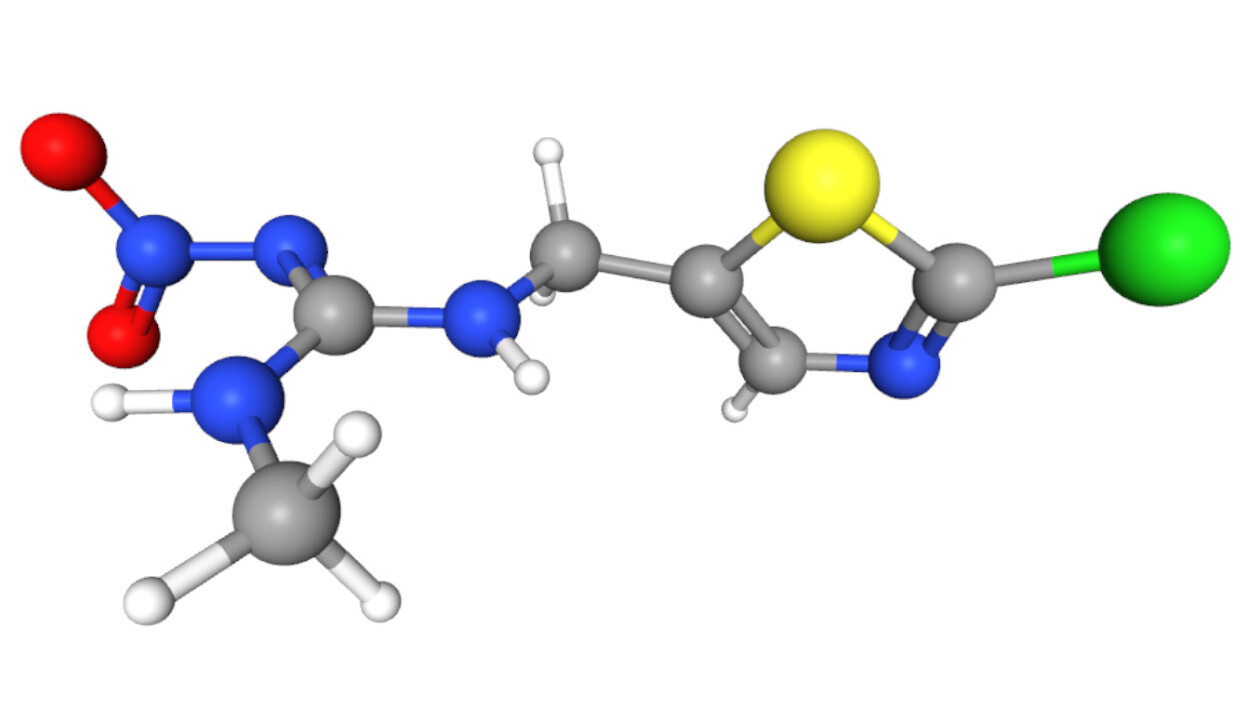
Clothianidin is a systemic insecticide widely used in agriculture, belonging to the neonicotinoid class.
Common name: clothianidin
Number CAS: 210880-92-5
Gross chemical formula: C6H8ClN5O2S
Chemical class: Neonicotinoid (IRAC group 4A), specifically from the nitroguanidine subclass with a thiazole ring (thiazole insecticide). It is structurally similar to imidacloprid and thiamethoxam, but with modifications that confer greater stability and selectivity.
Main names of commercial products in Brazil: Poncho, Inside FS and others.
Development history: Developed by Takeda Chemical Industries (now Sumitomo Chemical Takeda Agro) in co-development with Bayer AG in the late 1980s/early 1990s, based on modifications to nitenpyram. It was the first neonicotinoid with a thiazole ring, aiming for greater stability, low dose, and insect/mammal selectivity. First registered in Japan in 2001 (Dantotsu for food crops and Fullswing for lawns). In the US, conditional registration by the EPA in 2003 and unconditional registration in 2010 (for seed treatment of corn and canola). In Brazil, registrations occurred from the 2000s onwards, with emphasis on use in seed treatment of major crops.
Mechanism of action: Nicotinic acetylcholine receptor (nAChR) agonist in the central nervous system of insects. It binds irreversibly to postsynaptic receptors, causing nerve overstimulation, paralysis, and death. It does not inhibit acetylcholinesterase (unlike organophosphates/carbamates). It is systemic (absorbed by the plant via roots or seeds) and acts by contact and ingestion. It has a high affinity for insect receptors (low in mammals due to the blood-brain barrier).
Control spectrum: Broad spectrum, especially effective against sucking insects (aphids, leafhoppers, thrips, whiteflies) and some chewing/soil insects (larvae). Diabrotica(wireworms, crickets, beetles). Used on corn, soybeans, cotton, sugarcane, vegetables, and fruits. Excellent for initial seed protection (systemic translaminar). Less effective against adult lepidopteran pests.
Compatibilities and interactions
Compatible with many seed treatment fungicides (e.g., carbendazim + thiram, metalaxyl). Can be co-formulated with other insecticides (imidacloprid, fluoxastrobin) or fungicides. In tank mixtures, physicochemical incompatibilities should be avoided (always test). High toxicity to pollinators (bees) and aquatic invertebrates – restrictions on use near beehives or bodies of water. Studies show compatibility with some biologicals at low doses, but it is generally antagonistic to natural enemies.
Agronomic positioning: Primarily used in seed treatment (ST) for early systemic protection against early pests in corn (leafhopper, aphid, soil larvae), soybeans, cotton, and sugarcane. Also suitable for foliar or soil application in vegetables and fruits. Typical dose: 0,3-1,0 L/100 kg seeds. Strategic positioning in rotation with other modes of action (IRAC 4A) to delay resistance. Effective in IPM, but with monitoring for bees and environmental risk (persistent in the soil).
Patent numbers: EP 0376279, US 5034404 and others.
Other scientific points
Clothianidin exhibits excellent efficacy in controlling a wide variety of insect pests, such as Hemiptera, Thysanoptera, Coleoptera, Lepidoptera, and Diptera, even in small quantities, with systemic action and through various application methods. The structural characteristics of clothianidin include a thiazole ring and an open-chain guanidine skeleton. DOI 10.1021/jf1024938
UGT (UDP-glycosyltransferase) enzymes UGT36M1 and UGT306K1 confer resistance to clothianidin in Bradysia odoriphaga (root fly). UGT inhibitors synergize with the insecticide in the resistant strain, revealing a metabolic mechanism. - DOI 10.1016/j.pestbp.2025.106349 -
Cultivar Newsletter
Receive the latest agriculture news by email