Agrotalk Show 2025 discusses the future of agriculture and the economy
The new edition of the event will be held in Ribeirão Preto (SP) on April 27th
26.03.2025 | 17:11 (UTC -3)

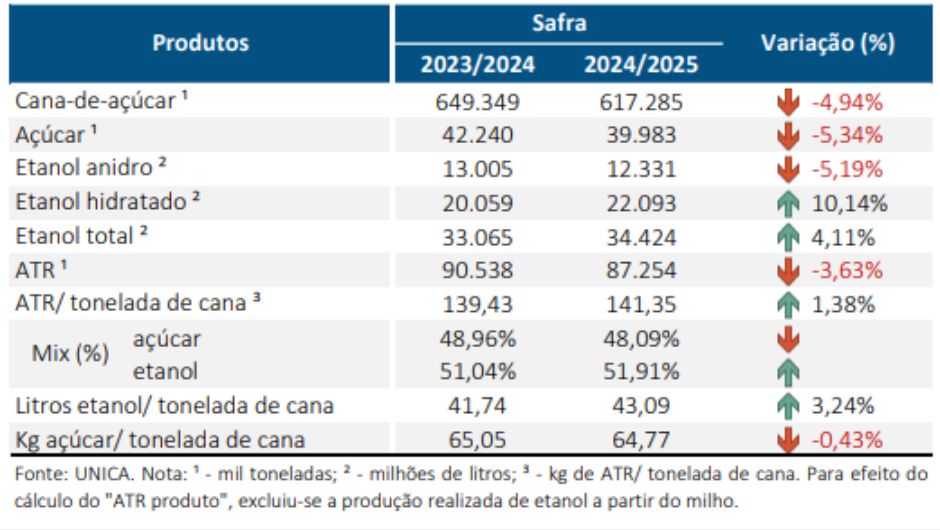
In the first half of March, the production units in the Center-South region processed 1,83 million tons compared to 2,22 million in the 2023/2024 harvest – which represents a drop of 17,81%. In the accumulated total for the 2024/2025 harvest up to March 16, milling reached 617,28 million tons, compared to 649,35 million tons recorded in the same period in the previous cycle – a drop of 4,94%.
In the first fifteen days of March, 19 units began the 2025/2026 harvest. At the end of the fortnight, 37 production units were in operation in the Center-South region, of which 22 units processed sugarcane, ten companies produced ethanol from corn and five flex plants. In the same period, in the 2023/2024 harvest, 41 production units operated.
According to Luciano Rodrigues, Unica’s Director of Sector Intelligence, “we are seeing the beginning of the resumption of milling at the mills now in March. In the second half of the month, at least 19 other production units intend to restart activities, but this schedule may change depending on the weather and operational conditions in each sugarcane region.”
Regarding the quality of the raw material, the level of Total Recoverable Sugars (ATR) recorded in the first half of March reached 99,17 kg of ATR per ton of sugarcane, against 109,96 kg per ton in the 2023/2024 harvest - a negative variation of 9,82%. In the accumulated harvest, the indicator marks 141,35 kg of ATR per ton, a slightly higher index (1,38%) than the last cycle in the same position.
Sugar production in the first fifteen days of March totaled only 52 thousand tons, registering a drop of 19,10% compared to the amount recorded in the same period in the 2023/2024 harvest (64,3 thousand tons). In the accumulated period since the beginning of the harvest until March 16, the production of the sweetener reached 39,98 million tons, against 42,24 million tons in the previous cycle (-5,34%).
In the first half of March, ethanol production by the Center-South units reached 441,5 million liters, of which 367 million liters were hydrated ethanol (+9,18%) and 74,6 million liters were anhydrous ethanol (+144,20%). In the current agricultural cycle, biofuel production totaled 34,42 billion liters (+4,11%), of which 22,09 billion were hydrated ethanol (+10,14%) and 12,33 billion were anhydrous ethanol (-5,19%).
Of the total ethanol produced in the first half of March, 82,77% was produced from corn, with a production of 365,47 million liters this year, compared to 259,04 million liters in the same period of the 2023/2024 cycle – an increase of 41,08%. Since the beginning of the harvest, corn ethanol production reached 7,83 billion liters – an increase of 31,22% compared to the same period last year.
In the first half of March, ethanol sales totaled 1,34 billion liters. In the domestic market, the volume of hydrated ethanol sold by units in the Center-South totaled 805,60 million liters, which represents a 15% drop compared to the same period of the previous harvest. Sales of anhydrous ethanol, in turn, reached 482,36 million liters, an increase of 4,18%.
From the beginning of the harvest until March 16, ethanol sales by units in the Center-South totaled 34,03 billion liters, representing growth of 8,91%. The accumulated volume of hydrated ethanol totaled 21,90 billion liters (+14,66%), while anhydrous ethanol reached 12,13 billion liters (-0,13%).
“Sales of hydrated ethanol continue to show significant growth of almost 15% in the accumulated harvest, guaranteeing the option of choice with each refueling and contributing effectively to the reduction of Brazilian consumers’ spending on fuel”, added Rodrigues.
Data from B3 up to March 24th indicate the issuance of 10,30 million credits in 2025 by biofuel producers. The amount of CBios available for trading held by the obligated party, non-obligated party and issuers totals 22,91 million decarbonization credits.
Receive the latest agriculture news by email


Receive the latest agriculture news by email