Mechanism can protect tomatoes against heat
Brown University study reveals critical phase and molecular mechanisms for high temperature tolerance
10.11.2024 | 16:32 (UTC -3)

The official launch of the Diamantino System (a tool for renovating degraded livestock areas with income generation during the process and without conversion to crops) is scheduled for tomorrow (12/11), at 19:30 pm, Brasília time. On the occasion, Embrapa and Latina Seeds, technology partners, will present data on system validation and answer questions. The broadcast will be made exclusively by Embrapa through its YouTube channel.
The objective of the live broadcast is to allow Brazilian cattle farmers to participate, ask questions and contribute to the new system. “Diamantino” follows the concept of pasture “renewal”, which “is to restore forage production by introducing a new species or cultivar, replacing the previous one”, a procedure generally indicated when more than 40% of the pasture is degraded.
However, at the same time, the System allows for the aggregation of income through the production of silage, for use on the property or for sale, amortizing or covering the costs of renewal. As it is a sustainability mechanism with returns for beef cattle farming itself, its slogan includes the expression “Renewal for livestock farming”.
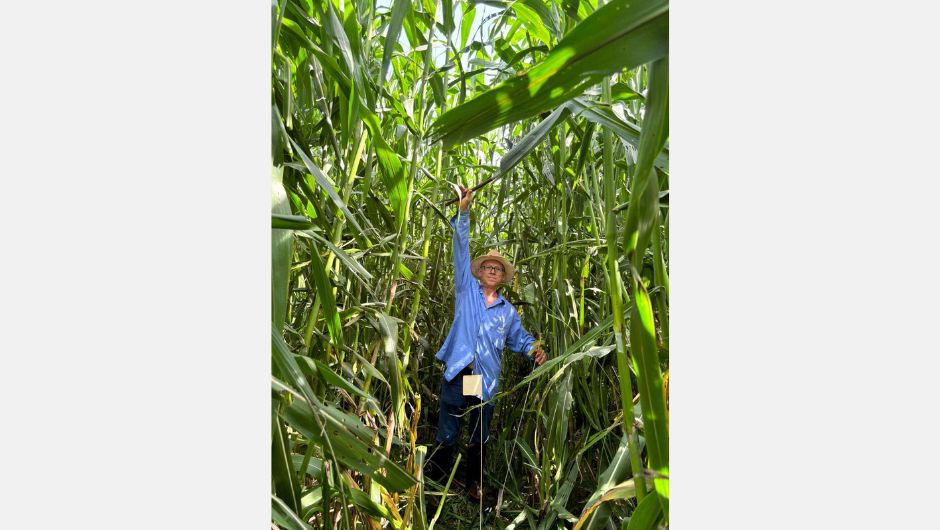
The structuring of the partnership, development of the project and validation in farmers' fields took four years (2021 to 2024) of work. The research originated the technical circular publication entitled “Diamantino System for silage production and pasture renewal”, authored by: Marciana Retore, Gessí Ceccon and Rodrigo Arroyo Garcia, from Embrapa Agropecuária Oeste, and Willian Sawa (pictured above), from Latina Seeds.
The study, whose registration was called “Sorghum with forages for production intensification”, involves evaluations of consortia of Sorghum biomass (Giant Sorghum from Latina Seeds) with Brachiaria (Marandu grass) and Panicum (BRS Zuri grass). The research was carried out in three municipalities in the south of Mato Grosso do Sul: Embrapa Agropecuária Oeste (Dourados) and on two private properties: Sítio Cantinho do Céu (Jateí) and Sítio Tropical (Vicentina).
Embrapa Agropecuária Oeste researcher Marciana Retore says that “the difference in the Diamantino System is the large production of bulky feed during the dry season, combined with pasture renewal. The expectation is that it will be adopted in degraded pasture areas, making them productive again and allowing livestock production to be intensified.”
Agricultural engineer and Embrapa analyst Gessí Ceccon says that the Diamantino System should be implemented at the beginning of the rainy season. Silage production should be carried out when the plants have approximately 30% dry mass. These values can be obtained 120 to 130 days after planting, depending on the region and climate. Subsequently, in an interval of another 50 to 60 days, the pasture will be renewed for grazing, precisely during the dry season.
Rafael Zanoni Fontes, Deputy Head of Research and Development at Embrapa Agropecuária Oeste, highlights the importance of collaboration between private and institutional entities in the development of innovative solutions such as the Diamantino System. According to him, the combination of knowledge between Embrapa and Latina Seeds has allowed the creation of a technology that goes beyond innovation, reaching larger scales and directly benefiting producers. “This partnership highlights the positive impact of cooperation between the production sector and research, promoting sustainability and efficiency in the field in several regions of Brazil,” says Rafael.
Latina Seeds CEO Willian Sawa believes that “Diamantino” contributes in an innovative way to the country’s environmental, social and economic policies and to Brazil’s image abroad by enabling the transformation of degraded areas into productive areas. “All with a lot of support, security, low investment, high level of sustainability and fast return/income for the producer,” he notes.
These attributes were highlighted in correspondence filed with the Ministry of Agriculture and Livestock (MAPA) on February 5, 2024, addressed to the Interministerial Management Committee of the National Program for the Conversion of Degraded Pastures into Sustainable Agricultural, Livestock and Forestry Production Systems (PNCPD). In it, Sawa reinforces that the new technology “allows the conversion of degraded pastures into high-yield pastures, space for efficient, productive and low-impact livestock farming, without the need to expand the area”.
The name “Diamantino” (registered trademark at INPI) is a reference to the city in Mato Grosso (where it was imagined) and refers to the preciousness of a diamond, cut to strengthen Brazilian livestock farming.
Receive the latest agriculture news by email


Receive the latest agriculture news by email