Researchers list 39 species of Colletotrichum associated with citrus fruits
Study highlights wide diversity, latent infections, and challenges for diagnosis, management, and biosecurity
15.09.2026 | 07:52 (UTC -3)
Schubert Peter, Cultivar Magazine
doi 10.3390/jof12090687
Researchers have identified 39 species of Colletotrichum associated with citrus in different regions of the world. This group includes pathogens capable of infecting leaves, branches, petals, and fruits. Some species also remain as endophytes or in latent infections. This diversity increases the challenges for diagnosis, phytosanitary management, and risk assessment of pathogen introduction into new areas.
Scientists identify Colletotrichum gloeosporioides as the most frequent species in citrus (doi 10.3390/jof12090687). The fungus occurs in various hosts and can colonize different plant tissues. Colletotrichum karstii occupies a prominent position among the species of the boninense complex. Colletotrichum siamense also has a wide distribution and is involved in diseases of fruits, leaves, and branches.
Associated diseases
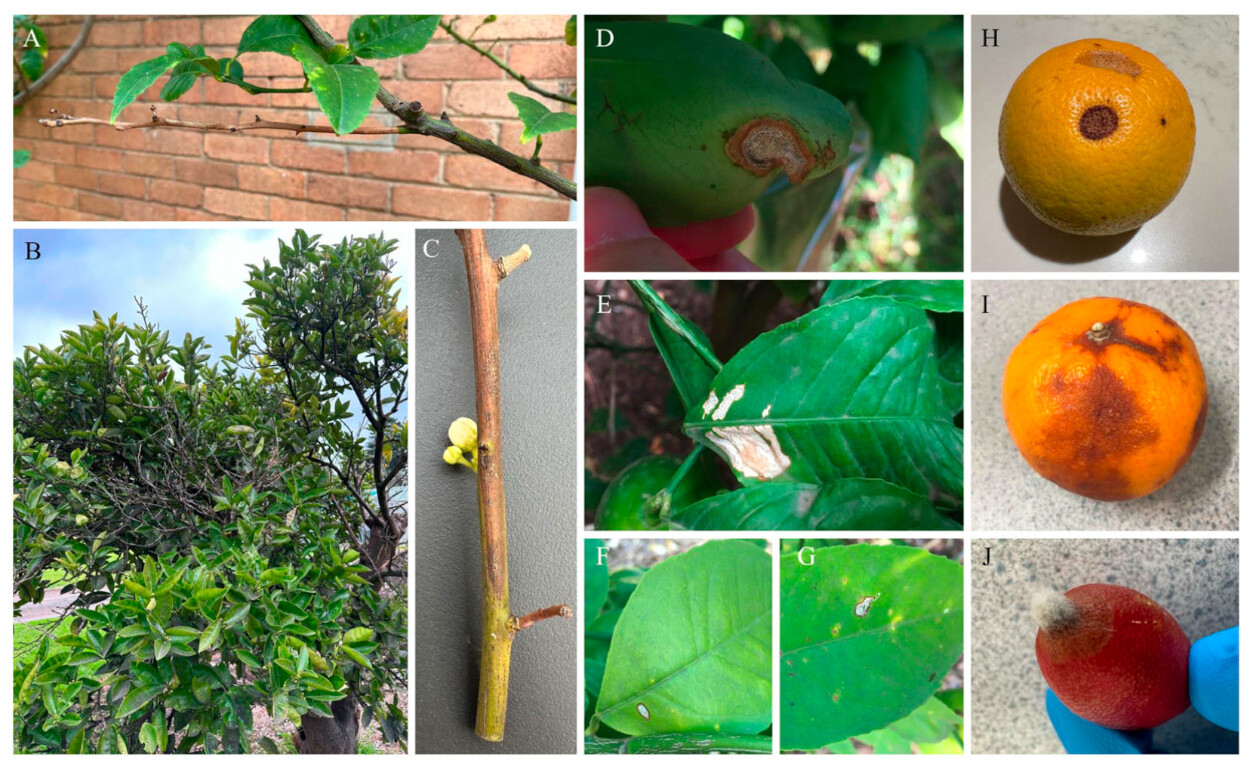
Diseases associated with this genus include anthracnose, branch and shoot dieback, premature fruit drop after flowering, and anthracnose of the Galician lemon. Anthracnose occurs before and after harvest. Symptoms include sunken necrotic lesions, leaf spots, tissue dieback, and fruit rot. Post-harvest infections can originate in the field.
The fungus can penetrate immature fruits and remain in a quiescent state. Disease development occurs during ripening or after harvest. Physiological changes in the fruit favor this transition. Ripening reduces some defense barriers and increases the availability of sugars. The pathogen then resumes growth and enlarges the lesions.
The study records fruit losses between 90% and 100% in anthracnose episodes under environmental conditions favorable to infection. These values correspond to situations reported in the literature and do not represent an average loss for citrus farming. For premature fruit drop after flowering, studies conducted in Brazil recorded productivity losses of up to 93% when flowering coincided with rainy periods.
High humidity
High humidity plays a central role in the epidemiological cycle. Colletotrichum species prefer temperatures between 25 and 28 degrees Celsius. Fruiting structures release spores after favorable conditions occur. Rain, wind, and irrigation promote dispersal to other plant parts.
After germination, many species form appressoria. These structures accumulate osmotically active compounds and develop turgor pressure of up to eight megapascals. This pressure allows the formation of a penetrating structure capable of crossing the cuticle and cell wall of the epidermis. Some species also use stomata or wounds as entry points.
This mechanism has direct implications for pathogenicity testing. Researchers warn against the exclusive use of inoculations after artificial wounds. Removing the barrier formed by the cuticle and epidermis can overestimate the infectivity. Assays with inoculation without wounding need to be integrated into the evaluation of isolates intended for risk and pathogenicity studies.
The analyzed studies also indicate a lack of strict host or tissue specificity in several species. Isolates obtained from one organ can cause symptoms in other tissues. Some fungi associated with citrus also occur in plants of other genera. Experiments with wounded tissues demonstrated cross-infection between different hosts. The researchers caution the need for caution in interpreting these results, as artificial wounding facilitates pathogen entry.
Latent behavior
Latent behavior exacerbates the problem for biosecurity. Colletotrichum gloeosporioides and Colletotrichum karstii, for example, have already been isolated from asymptomatic tissues. Other members of the genus appear as endophytes. Plant material without symptoms can, therefore, carry the fungus without visual detection during inspections. Dead leaves can also harbor saprobic species and act as a source of inoculum.
Geographic distribution also depends on thermal adaptation. Colletotrichum gloeosporioides maintains growth over a wide temperature range and appears in tropical, subtropical, Mediterranean, temperate, and semi-arid regions. Colletotrichum siamense exhibits optimal growth near 30 degrees Celsius and frequently appears in tropical regions. Colletotrichum acutatum and Colletotrichum karstii exhibit optimum growth near 24 degrees Celsius, with a marked reduction in growth at higher temperatures.
Correct identification
For researchers, the correct identification of species represents the first step in phytosanitary assessment. Some historical records used only morphological characteristics, ITS region sequences, or insufficient markers to separate closely related species. Scientists recommend a polyphasic approach. This procedure combines phylogeny with multiple genes, morphological characteristics, and geographic and ecological information.
Rapid molecular methods can also expand inspection capabilities. Real-time quantitative PCR already allows for the detection and quantification of different Colletotrichum species in other agricultural systems, including in asymptomatic tissues. Scientists point to the potential for developing specific assays targeting aggressive species associated with citrus. One obstacle involves selecting specific primers given the increasing number of closely related species.
Researchers also advocate for further studies on host range, aggressiveness, and environmental adaptation. Bioassays with different temperatures, humidity levels, and hosts can indicate the establishment potential of newly detected species. This information allows for estimating risks to citrus orchards, other crops, and native plants, as well as supporting quarantine measures and breeding programs for resistance.