Mosaic reports a loss of US$72 million in the third quarter
The result contrasts with a profit of US$411 million in 2025; Brazilian operations register a drop in sales
03.11.2026 | 19:01 (UTC -3)
Advances in computational protein modeling are expanding the possibilities for developing pesticides with new mechanisms of action. However, the choice of molecular targets remains crucial for product efficacy and reducing the risk of resistance. Jonathan Gressel, from the Weizmann Institute of Science in Israel, and Stephen O. Duke, from the University of Mississippi in the United States, have compiled seven criteria to guide this selection.
Researchers highlight the potential of tools like AlphaFold, which has replaced X-ray crystallography in visualizing protein structures, and proprietary molecular design algorithms. These technologies allow the development of small molecules and peptides capable of interacting with regions previously considered inaccessible. This advancement expands the universe of possible targets for herbicides, fungicides, and insecticides. Since herbicides account for the majority of the volume, treated area, and market value, most of the examples cited involve weeds.
Historically, the discovery of pesticides has relied on random screening of chemical compounds, with the exception of products developed from natural molecules. The molecular targets of almost all pioneering pesticides in a new class of mechanism of action were unknown at the time of commercial launch. Although eukaryotic organisms considered pests possess more than 10 different proteins, only a tiny fraction constitute targets for available products.
According to Gressel and Duke, the selection of new targets should consider the possibility of resistance evolution. Molecules capable of inhibiting essential enzymes are not always effective in the body. Furthermore, genetic alterations can reduce the sensitivity of the targets or increase the compounds' ability to degrade.
One of the main recommendations involves the development of molecules capable of acting on two or more molecular targets. This characteristic would reduce the probability of resistance associated with specific mutations. According to the authors' estimate, if resistance to a single target appears in ten years, the need for simultaneous mutations in two targets would increase this timeframe to one hundred years.
The researchers present two strategies. The first involves inhibiting proteins with different functions. The second consists of disrupting interactions between proteins or between subunits of the same protein.
The herbicide rimisoxafen appears as an example of a compound with action on two targets. The molecule inhibits phytoene desaturase and solanesyl diphosphate synthase, enzymes essential for carotenoid biosynthesis. Researchers note, however, the lack of information about the intentional or accidental origin of this dual activity.
The combination of targets requires similar inhibitory concentrations in both enzymes. If one of them exhibits significantly higher sensitivity, the more sensitive target will determine the dose applied in the field. In this situation, the second target offers little contribution to controlling and reducing selection pressure for resistance.
The speed of action also affects the outcome. A fast mechanism, such as the inhibition of protoporphyrinogen oxidase (PPO), would antagonize a slow mechanism, such as the inhibition of acetolactate synthase (ALS), both present in the same molecule. The relationship is reversed between inhibitors of photosystem II and hydroxyphenylpyruvate dioxygenase (HPPD), which exhibit synergy and would make a molecule acting on both targets attractive.
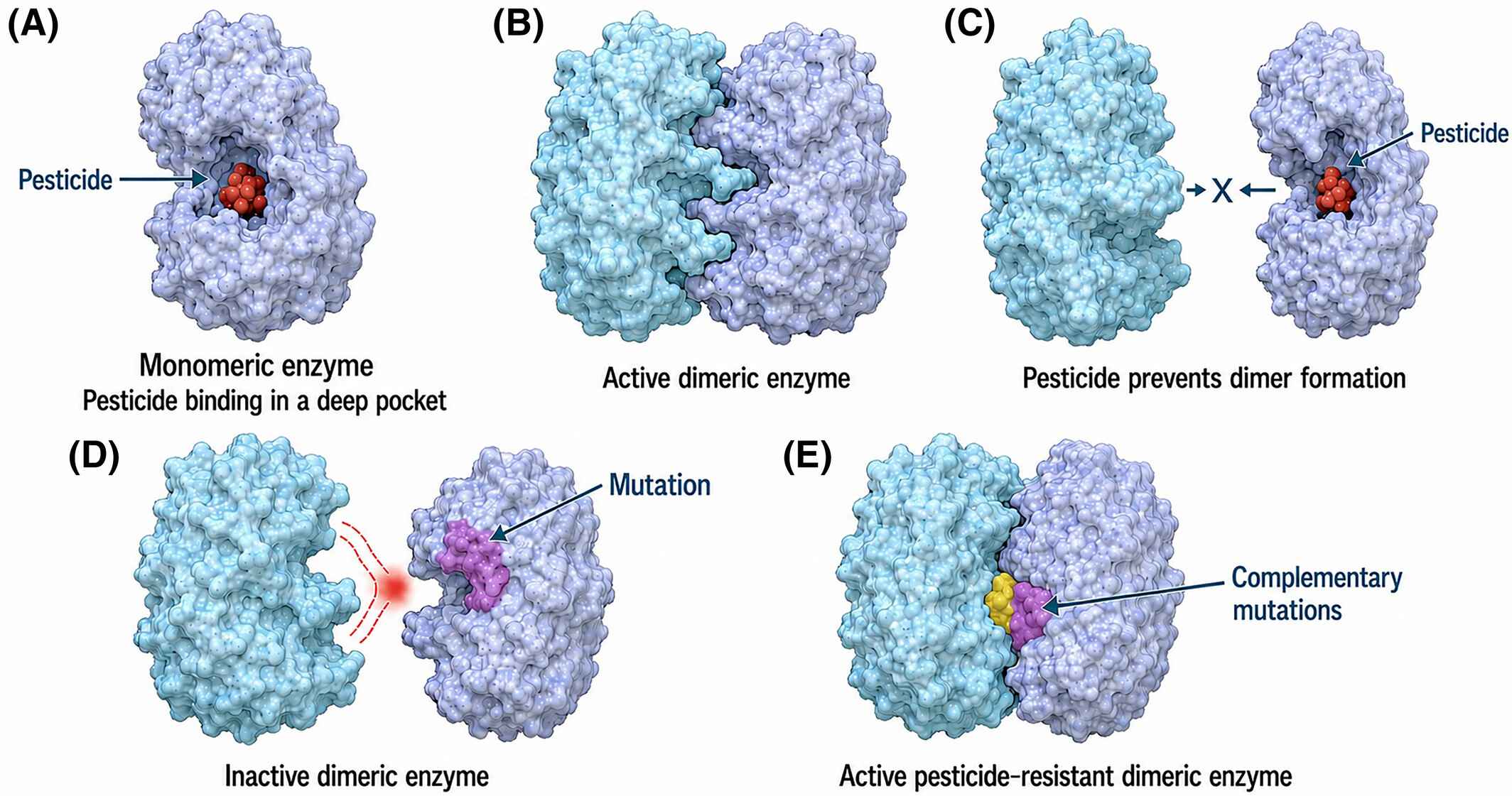
Another pathway involves molecules capable of preventing the association of protein subunits. Certain enzymes depend on this interaction to function. A mutation capable of preventing the binding of the detrimental agent could also compromise the formation of the active enzyme.
In this scenario, resistance would require complementary mutations in different protein components. Researchers consider this combination less likely than alterations in a single binding site.
The strategy would be of particular interest to targets already affected by resistance. Weeds resistant to ALS inhibitors would remain susceptible to a compound that blocks the association between the enzyme's subunits, because the binding sites differ from the current ones. A study co-authored by Gressel describes molecules designed to disrupt the interaction between O-acetylserine sulfhydrylase and serine acetyltransferase, a step necessary for cysteine synthesis in plants.
The pharmaceutical industry paved the way by developing compounds that target protein interfaces, which were considered unreachable because they have shallow binding regions, unlike the deep cavities exploited by conventional drugs.
The quantity of the target protein represents another important factor. Very abundant enzymes may require high doses to achieve sufficient levels of inhibition. A compound developed against rubisco, the most abundant protein in green plants, would require impractical quantities to control weeds.
Scientists cite the enzyme acetolactate synthase (ALS) as a counterexample. Its concentration in leaves is about 36 times lower than that of ketol acid reductase isomerase (KARI) and four times lower than that of dihydroxyacid dehydratase (DHAD), the other two enzymes in the branched-chain amino acid pathway. This low abundance may contribute to the effectiveness of certain herbicides at doses of a few grams per hectare.
Neither of the two most abundant enzymes yielded commercial inhibitors, despite good results in in vitro assays. The authors also suggest transcription factors, proteins of very low abundance, as possible targets.
Increased production of the target protein is also a known mechanism of resistance. Some weeds have developed resistance to glyphosate through gene amplification, a process responsible for increasing the amount of the EPSPS enzyme. Similar mechanisms occur with ACCase inhibitors and fungicides.
Researchers also recommend avoiding targets with alternative metabolic pathways. The presence of enzymes capable of compensating for inhibition can preserve organism function and compromise control. Ascorbate biosynthesis, which occurs via three distinct routes in plants and insects, illustrates the problem.
The selection of the chemical structure deserves similar attention. According to the article, more than two-thirds of registered pesticides are hydrophobic heterocycles built on a few common chemical skeletons. When a promising molecule emerges, the industry often transfers the active group to other skeletons of the same category.
These characteristics may favor degradation by enzymes associated with metabolic resistance, especially glutathione transferases and cytochrome P450 monooxygenases.
Researchers point to differences in hydrophilic compounds, such as glyphosate, glufosinate, and paraquat. Despite prolonged use, these herbicides do not exhibit substantial known metabolic resistance, according to the analysis.
In the case of insecticides, ester linkages can facilitate degradation by esterases. The study recommends avoiding structures susceptible to these enzymes during the development of new molecules.
The recommendation also extends to peptide-based pesticides. While they show potential for targeting new agents, these molecules can be degraded by proteases. Cyclic structures, D amino acids, and non-essential amino acids represent alternatives to increase their stability.
Another criterion establishes the need to verify whether partial inhibition of the target causes the organism's death. Complete elimination of an enzyme in genetic experiments does not guarantee similar efficacy with the application of a pesticide. The authors recommend tests with RNA interference under an inducible promoter, which reduce only part of the target protein and approximate the real-world conditions of use.
Researchers highlight the importance of compounds capable of triggering the accumulation of toxic substances. Protoporphyrinogen oxidase (PPO) inhibitor herbicides, for example, cause an accumulation of protoporphyrin IX. In the presence of light and oxygen, this substance promotes the formation of singlet oxygen, which is highly toxic to cells.
Other herbicides exhibit similar effects through the production of reactive oxygen species, as is the case with paraquat and diquat, or through the accumulation of phytotoxic metabolites, observed with ALS inhibitors and glyphosate. These processes allow for lethal effects even without complete inhibition of the target proteins.
Safety is also part of the proposed criteria, in a formulation distinct from that adopted by part of the industry. Several companies require that the target not exist in mammals. Gressel and Duke consider this requirement too restrictive and note that commercial herbicide targets belonging to 10 of the 25 groups in the Herbicide Resistance Action Committee (HRAC) classification have orthologs in mammals.
According to the authors, it is sufficient that the binding region be sufficiently different from the corresponding structure in mammals, a condition that current molecular tools allow us to predict. This alternative expands the universe of available targets without raising regulatory barriers. Compounds that act on tubulins from plants and fungi and on dihydroorotate dehydrogenase illustrate the situation.
Another requirement involves the similarity of the connecting region between species of agricultural importance, a condition for the market to justify the investment. Among the groups mentioned are weeds from the Poaceae and Amaranthaceae families, insects from the Lepidoptera and Coleoptera orders, and fungi from the Fusarium genus. Development decisions based on a single model species, such as Arabidopsis, are considered insufficient.
Gressel and Duke, however, highlight the existence of additional resistance mechanisms, such as exclusion, expulsion, compartmentalization in vacuoles, and binding to cell wall components. The gradual combination of these mechanisms can increase population tolerance, a process that the authors associate with the use of reduced doses.
The study also recommends evaluating the penetration of the compounds into organisms, their arrival at cellular targets, their environmental persistence, and the dissipation of residues in crops before harvest. These factors influence the commercial viability and safety of the products (doi 10.1002/ps.71458).
Receive the latest agriculture news by email



Receive the latest agriculture news by email