El Niño requires strategic management in the 2026/27 harvest
This phenomenon is expected to increase disease pressure in soybeans, corn, and wheat, and will require phytosanitary planning.
14.07.2026 | 16:49 (UTC -3)
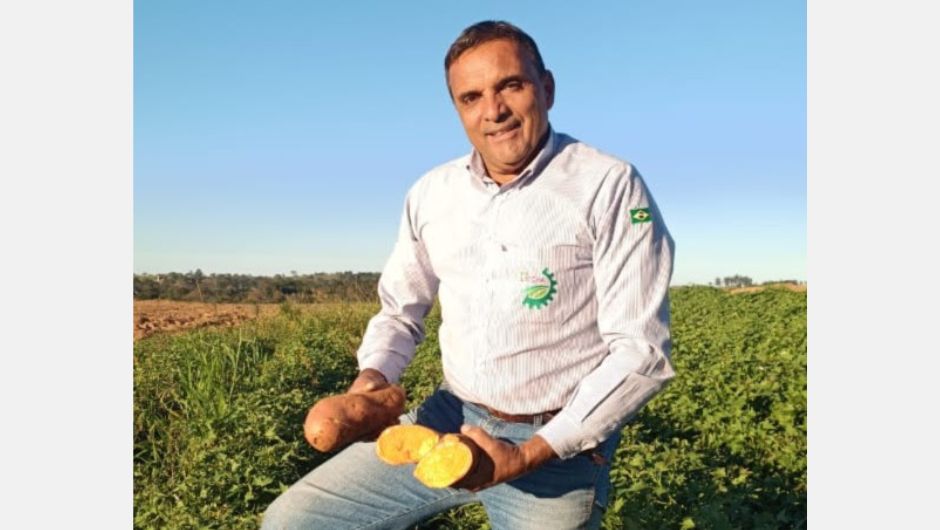
After facing successive losses with tomato production and even trying to start over in Mato Grosso do Sul, farmer Luiz Rocha (pictured) returned to Presidente Prudente determined to bet on a crop still little known in the region: sweet potatoes. That was in 1986. Almost four decades later, he cultivates about 160 hectares, produces approximately 160 boxes per year, and supplies markets in Brazil, Canada, the Netherlands, and Mercosur countries. For him, the great turning point in this story had one protagonist: public research in São Paulo.
The turning point came when the Apta Regional office in Presidente Prudente, a unit of the Agribusiness Research Directorate (Apta) of the São Paulo State Department of Agriculture and Supply (SAA), began working with producers in the region. Researcher Sônia Marangoni introduced virus-free seedlings of the Canadian variety, allowing for a significant leap in crop productivity. "She was our godmother. Our production was around 600 boxes per hectare. The research brought a virus-free plant, and we managed to practically double that productivity. Today we produce more than double what we did back then. This happened thanks to the research," says Luiz Rocha.
Increased productivity was accompanied by gains in quality, opening doors to new markets. "Along with production came quality. That's what allowed us to conquer foreign markets," the producer points out. For Luiz, research is now one of the main pillars of the competitiveness of São Paulo's agribusiness. "Agribusiness doesn't move forward without research. The challenges are increasingly greater, and those who help find the solutions are the researchers. I am very grateful to Apta and IAC. Without them, we would be stagnant."
After transforming his productivity with technologies developed by Apta, Luiz returned to investing in public research when he learned about the latest innovation from the Agronomic Institute (IAC): the IAC Dom Pedro II sweet potato. Developed through conventional genetic improvement, without transgenics, the cultivar combines high productivity, earliness, excellent culinary quality, and a nutritional advantage that can contribute to combating so-called "hidden hunger," characterized by vitamin and mineral deficiencies.
Compared to the most widely planted white-fleshed cultivars in Brazil, IAC Dom Pedro II has a carotenoid content up to 64,71 times higher, reaching up to 77 micrograms of beta-carotene per gram of fresh pulp, while conventional varieties have less than 1 microgram. Consuming just 30 to 60 grams of this cultivar is enough to meet the daily requirement of beta-carotene, a precursor of vitamin A, an essential nutrient for healthy vision, skin, and the immune system.
In addition to its nutritional profile, the new cultivar presents an average commercial productivity of 67,18 tons per hectare, a performance 48,6% higher than that of the Canadense cultivar, the main variety cultivated in São Paulo, as well as surpassing Mineirinha by 74,9% and Uruguaiana by 120,99%. The cycle is also earlier: between 100 and 120 days in spring/summer and 120 to 150 days in autumn/winter. "This sweet potato presents superior productivity to the main variety cultivated in the State of São Paulo," explains IAC researcher Valdemir Antonio Peressin, responsible for the development of the cultivar.
Luiz Rocha learned about the IAC Dom Pedro II variety even before its commercial launch, when researcher Valdemir Peressin presented the new cultivar to producers. As soon as he received authorization to cultivate it, he decided to plant it on his property. "When I was able to plant it, I really liked it. It's a very productive, tasty potato, rich in beta-carotene. It's a variety that has everything to grow," he says.
In cultivated areas, productivity already reaches up to 1.200 boxes per hectare. For the producer, however, the main challenge is still outside the farm gate. "The market finds the potato beautiful and of good quality, but still buys little because the consumer doesn't know it. What's lacking is promotion. The housewife who tries it approves. The challenge is to get this potato to the consumer."
According to Luiz, the IAC Dom Pedro II offers benefits to both producers and consumers. "It's good for the producer because it produces very well. And it's excellent for the consumer, who gets a high-quality food with much greater nutritional value."
Luiz Rocha's career demonstrates how investment in science transcends the boundaries of laboratories and reaches the field in the form of income, productivity, competitiveness, and more nutritious food. By developing technologies capable of increasing crop efficiency and offering biofortified cultivars, such as IAC Dom Pedro II, Apta reaffirms its commitment to a more sustainable and innovative agriculture, prepared to meet the challenges of food security.
Receive the latest agriculture news by email



Receive the latest agriculture news by email