Body size affects thermal acclimation of Solenopsis invicta
Medium and small worker ants developed tolerance to cold and heat after 15 days of exposure
20.09.2026 | 16:09 (UTC -3)

The latest Hedgepoint Global Markets report on the coffee market shows that Arabica futures have lost momentum in recent days, trading in the 270-280 c/lb range. Although certified stocks remain at their lowest levels in decades and still offer some support to prices, weather conditions in Brazil and increased exports are increasing downward pressure in the short term, with the December contract potentially trading below 280 c/lb.
In August, total Brazilian coffee exports reached 4,16 million bags (M scs), a new record for the month and a 31% increase over August 2025. Green coffee shipments totaled 3,8 M scs, also 31% higher than a year earlier. At the same time, rainfall favored the development of the 2027/28 crop, with some regions already registering the first flowering and accumulated rainfall in September above the ten-year average in most producing areas.
“Certified inventories remain at their lowest levels in decades and provide some support to prices. However, the increase in inventories pending classification, the weather in Brazil, and the growth of exports could amplify the downward pressure, with the December contract potentially closer to 270 c/lb,” says Laleska Moda, market intelligence analyst at Hedgepoint Global Markets.
The analysis also indicates that the pace of Brazilian exports is helping to reduce concerns about the immediate availability of coffee, especially after months of slower sales by producers and weaker shipments. The data suggests that Brazilian coffee is finally reaching consumer markets.
According to data from Cecafé, Brazil exported 4,16 million bags of green and processed coffee in August, a 31% increase compared to the same period in 2025 and a new record for the month. Considering only green coffee, shipments totaled 3,8 million bags, a 31,1% increase year-on-year and a 42,7% increase compared to July. Within this volume, Arabica exports grew by more than 1 million bags in the month, reaching 2,8 million bags, a 25,7% increase compared to August 2025. Robusta shipments reached the highest volume in history, with 953,5 bags, a 53,6% increase in one year.
The United States and Belgium were the two largest importers of Brazilian coffee in August, both with volumes exceeding half a million bags. These two countries are usually among the top five destinations for Brazilian exports, but the strong monthly and annual growth in shipments comes after news that large companies are expected to send approximately 300 bags of Arabica coffee to ICE-certified stocks, increasing the prospects of more coffee reaching warehouses in the United States and Antwerp.
Currently, the ICE certified stock report indicates that 31,16 bags of Brazilian coffee are awaiting classification in the Antwerp warehouse. This volume, however, may increase in the coming weeks.
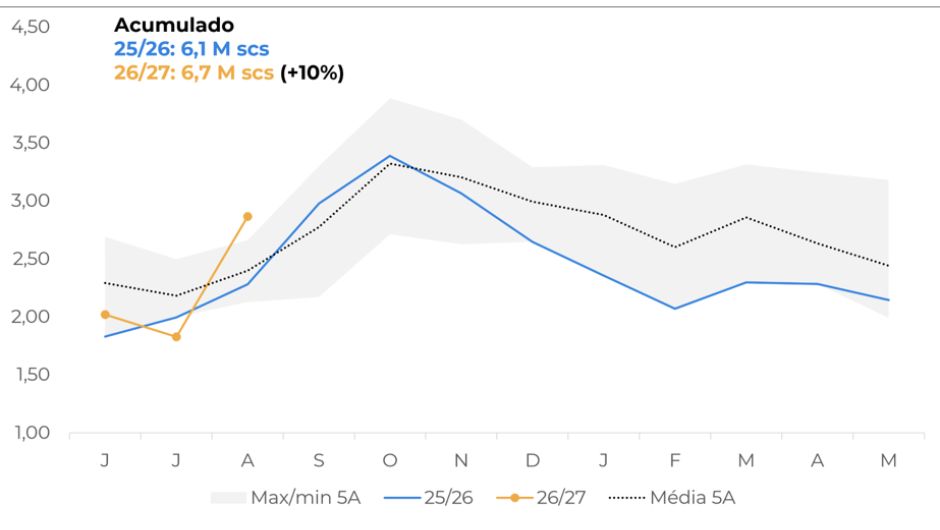
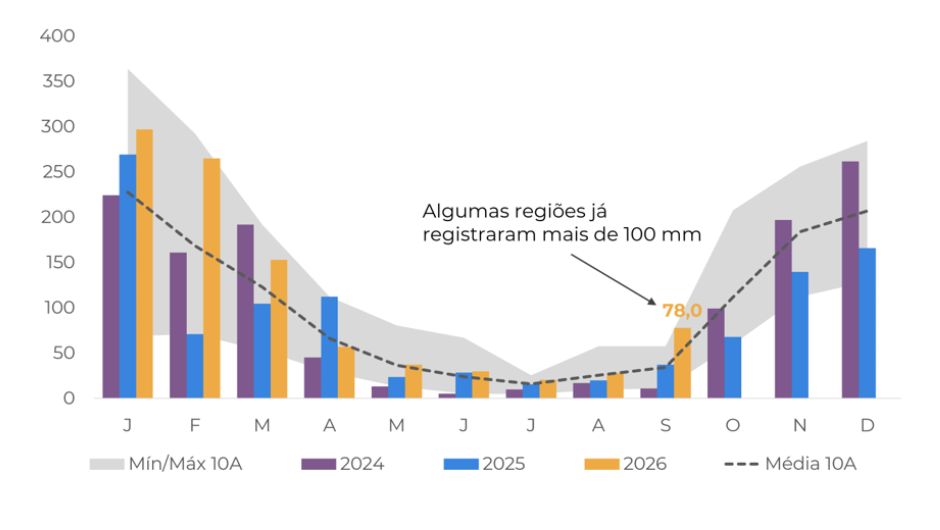
With the 2026/27 harvest practically completed in August, market attention shifted to weather conditions and the development of the 2027/28 Brazilian crop. Since the end of August, rainfall has reached all producing regions. Partial accumulations for September indicate rainfall above the average of the last ten years in most coffee-growing areas, with the exception of Chapada da Bahia and the Atlantic/South region. This pattern is likely being influenced by the El Niño phenomenon.
Some Arabica and Robusta producing regions have already recorded the first flowering of the 2027/28 crop, although more widespread flowering is still expected. Forecasts indicate continued rainfall throughout the remainder of September and during October, favoring soil moisture levels and crop development, although excessive rainfall volumes should be closely monitored.
“Although it is still too early to estimate the 2027/28 crop production, the expansion of the planted area in recent years, combined with favorable weather conditions so far, could partially offset the negative effects of the low biennial year for Arabica and sustain the productive potential. Thus, the evolution of the weather in the coming months will be fundamental to assessing the overall supply balance of the next crop,” says Laleska.
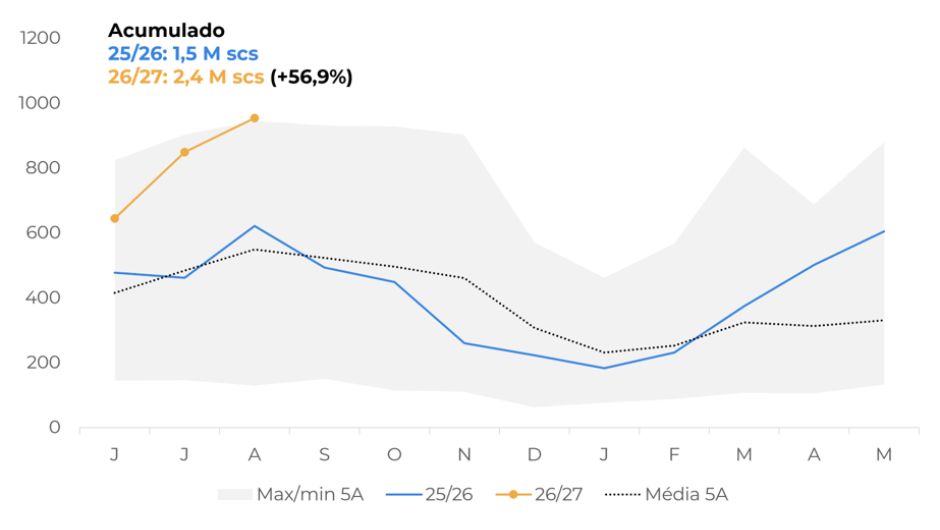
In the Robusta market, Vietnam's exports remained above average in August, reinforcing short-term supply prospects. The country exported 2,1 million sacks in the month, the highest volume for August in seven years, reaching a cumulative total of 27,7 million sacks in the 2025/26 crop year (October-August). This result represents a 19,6% increase compared to the 2024/25 crop year and one of the best performances of the last seven cycles.
On the other hand, stocks in the country are at extremely low levels, which tends to limit shipments in the coming months. Furthermore, the potential impacts of El Niño remain on the radar. Since the beginning of the 2026/27 crop season, accumulated rainfall in Vietnam has generally remained below average, and some regions are already expecting a reduction in production this year.
Nevertheless, due to the expansion of the cultivated area in recent years, Hedgepoint continues to project a production similar to that of the 2025/26 crop, at 30,5 million bags. Some producers are expected to begin fieldwork for the 2026/27 crop in early October, but more significant volumes of coffee are expected to reach the market only after November.
There is still a risk that El Niño will affect the 2027/28 crop cycle in Vietnam, especially because the phenomenon tends to prolong the dry season, reducing soil moisture and the availability of water for irrigation. There is also a risk of impacts on the 2027/28 crop in Indonesia, which is already developing in Robusta-producing regions. In this context, prices may find support in the coming months, depending on the intensity of El Niño's effects on production in the main producing countries.
“El Niño could prolong the dry season in Vietnam and reduce the availability of water for irrigation. The potential effects on Vietnam and Indonesia could support Robusta prices in the coming months,” reports Laleska.
In summary, Arabica futures have lost momentum in recent days as improved supply prospects have weighed on the market, although certified stocks remain at historically low levels and still provide some price support. Record Brazilian export performance in August has reduced concerns about short-term availability and indicated that Brazilian coffee is reaching key consumer markets, including the United States and Belgium. The possibility of additional Brazilian coffee entering ICE certified stocks could further reinforce the perception of a more comfortable supply in the short term.
Attention is also focused on the development of the 2027/28 crop. Widespread rainfall in Brazil and the recording of the first flowering have improved production prospects, while favorable weather conditions and the expansion of the cultivated area may partially offset the low biennial cycle of Arabica. In Robusta, Vietnam continues to export high volumes, although domestic stocks are increasingly tight. The risks associated with El Niño in the upcoming crops in Vietnam and Indonesia place weather development among the main factors to be monitored for price direction in the coming months.
"The weather in the main producing regions will continue to be a determining factor for the overall supply balance and the direction of prices," Laleska points out.
Receive the latest agriculture news by email



Receive the latest agriculture news by email