Mosaic reports a loss of US$72 million in the third quarter
The result contrasts with a profit of US$411 million in 2025; Brazilian operations register a drop in sales
03.11.2026 | 19:01 (UTC -3)
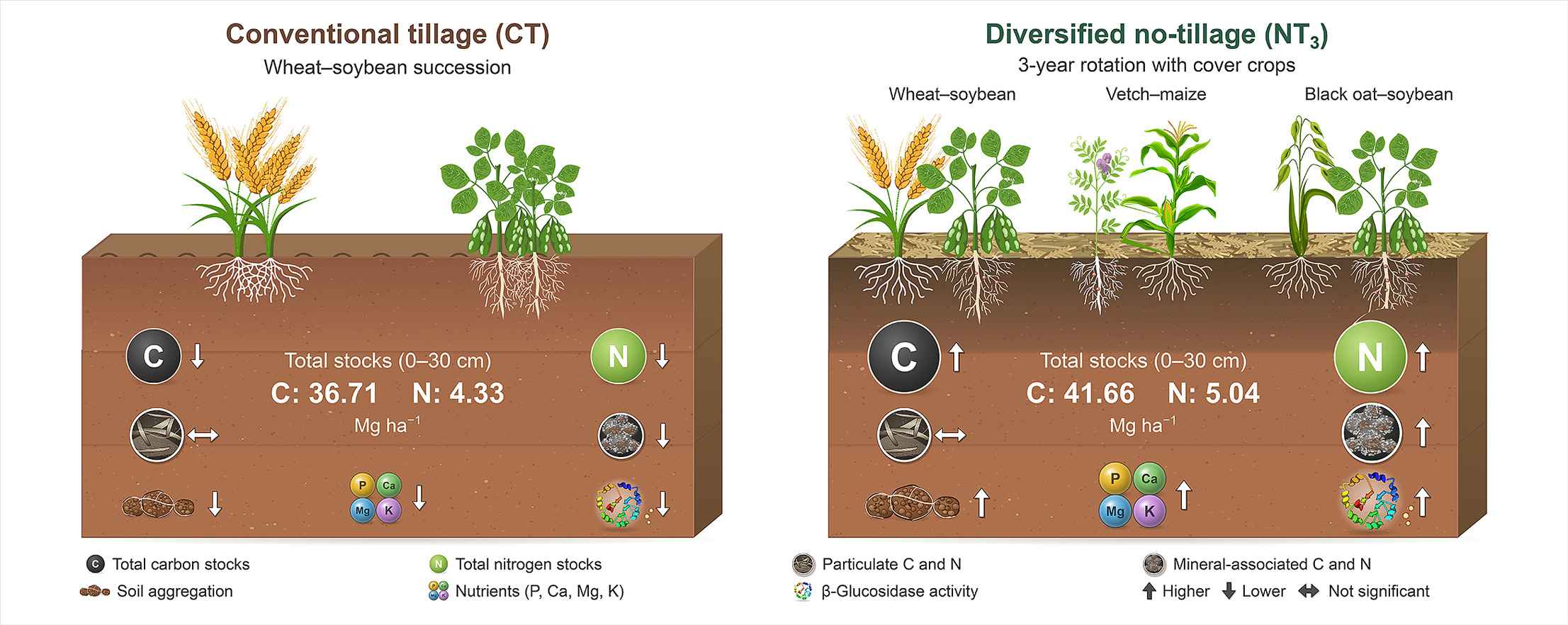
No-till farming systems maintained carbon stocks at least 30% higher than conventional tillage in the 0-10 centimeter soil layer. Nitrogen stocks were up to 36% higher. The results are part of a 32-year experiment conducted in Paraguay with different cropping systems and crop rotations.
The research took place at the Capitán Miranda experimental station of the Paraguayan Institute of Agricultural Technology (IPTA), in the department of Itapúa. Scientists evaluated five management systems, including conventional tillage, reduced tillage, and three no-till planting methods.
The treatments used successive wheat (Triticum aestivum) and soybean (Glycine max) crops, as well as diversified rotations with corn (Zea mays), black oats (Avena strigosa), and vetch (Vicia villosa).
In the 0 to 30 centimeter layer, carbon stocks ranged from 36,7 to 44,8 tons per hectare. The no-till system with rotation of black oats, soybeans, and wheat showed a carbon stock at least 22% higher than that of conventional tillage.
Nitrogen stocks ranged from 4,33 to 5,04 tons per hectare. The best result occurred in the system with the greatest crop diversification, with stocks 17% higher than in conventional tillage.
Diversification also favored the storage of carbon and nitrogen in the organic matter associated with the minerals. In the surface layer, the more diversified system showed 23% higher carbon stocks and 25% higher nitrogen stocks in this fraction, compared to conventional preparation.
Researchers have identified positive associations between organic matter and soil quality indicators, including phosphorus availability, aggregate stability, and beta-glucosidase enzyme activity.
Despite the benefits, diversification did not provide consistent increases in total carbon stocks among no-till systems. The results indicate the importance of fertility management and the supply of plant residues to increase carbon storage in the soil. Over the 32 years, the area did not receive liming or gypsum application, and the pH remained below 5,5 in all systems. Therefore, the scientists assess that the observed carbon and nitrogen gains tend to be conservative compared to what the same systems could achieve with soil acidity correction (doi 10.1016/j.csag.2026.100141).
Receive the latest agriculture news by email



Receive the latest agriculture news by email