Technology is BASF's bet to increase agricultural productivity
A fungicide with a novel molecule and biotechnology against nematodes are among the innovations presented by the company
04.09.2026 | 17:22 (UTC -3)
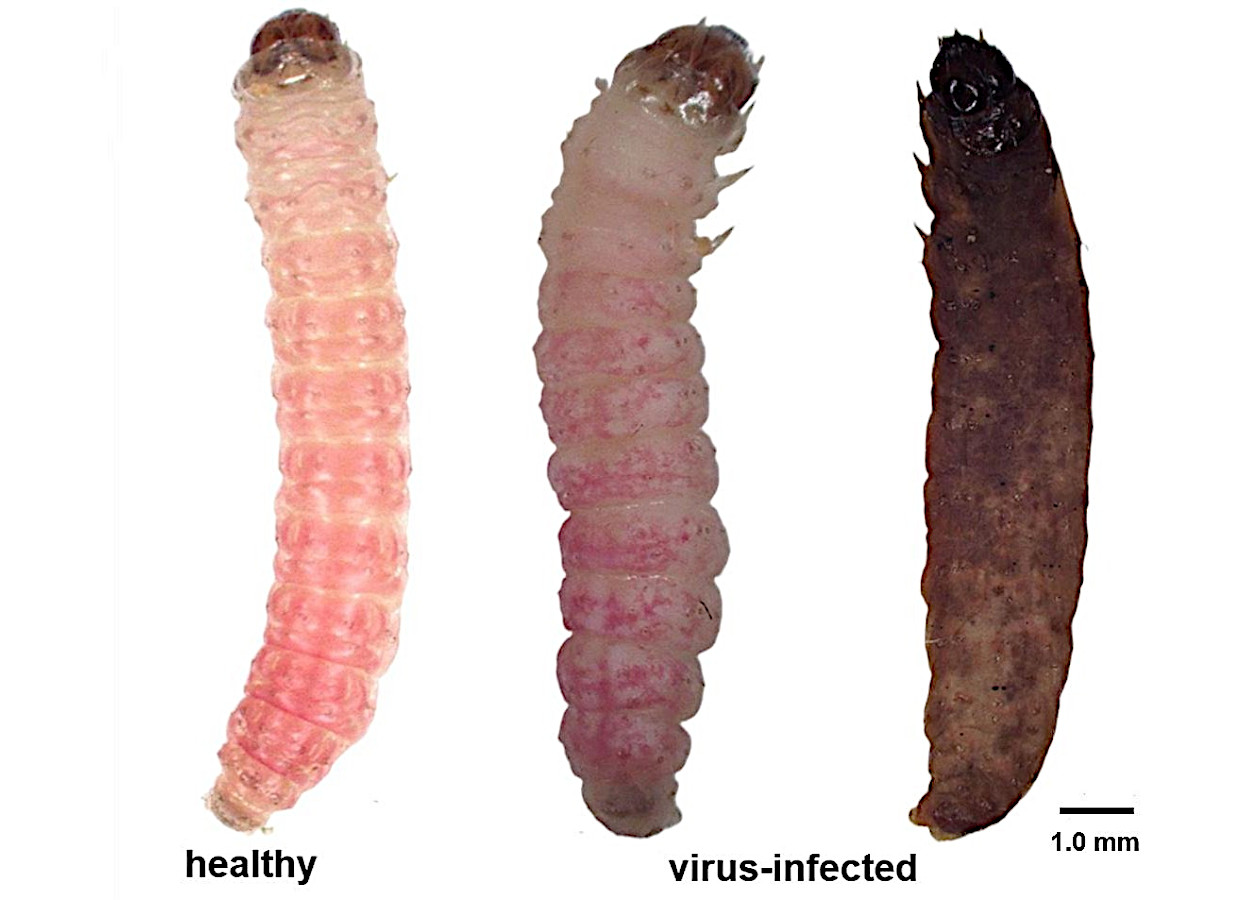
Researchers have identified a new nucleopolyhedrovirus with potential for the biological control of Cydia pomonella, a pest in apple orchards. The virus, named Cydia pomonella nucleopolyhedrovirus (CypoNPV), emerged in a population of the insect maintained in the laboratory. Tests indicated high pathogenicity against newly hatched larvae. Tests conducted in an orchard during two growing seasons recorded control of 77,78% in 2024 and 65,48% in 2026.
The study started with a laboratory population with no apparent viral infection (doi 10.1016/j.pestbp.2026.107339). Only 3,14% of individuals showed visible signs of the disease. The researchers isolated the agent from these larvae. Subsequent inoculation caused typical baculovirus symptoms, such as body swelling, pink or brown lesions, and liquefaction after death.
Morphological and molecular analyses supported the classification of the isolate as a novel nucleopolyhedrovirus of Cydia pomonella. The occlusion bodies were predominantly spherical or ellipsoidal in shape, with a diameter between 0,5 and 1,1 micrometers. Each body contained one to six rod-shaped virions.
The CypoNPV genome has 112.909 base pairs and a guanine plus cytosine content of 34,30%. Analysis identified 124 open reading frames with more than 150 nucleotides. Of these, 113 showed homology with genes already described in baculoviruses. Another 11 appeared to be unique to the new virus.
Phylogenetic analysis utilized 38 core baculovirus genes. CypoNPV was placed in group II of the Alphabaculoviruses. The closest genetic proximity was to the Cryptophlebia peltastica nucleopolyhedrovirus. Even so, the genetic distances used in the taxonomic delimitation supported the identification of the isolate as a distinct virus.
Scientists also evaluated the effects of occult infection on the development of Cydia pomonella. The 43,40% reduction in the number of viral copies did not improve the main population parameters. Infected populations without treatment and virus-free populations showed similar dynamics. No significant differences emerged for larval duration, pupation rate, adult longevity, total pre-oviposition period, intrinsic growth rate, net reproduction rate, and finite growth rate.
In bioassays, first instar larvae received different concentrations of occlusion bodies. Mortality began two days after inoculation. The effect increased with concentration. At a dose of 1,79 million occlusion bodies per milliliter, survival reached zero after seven days. At this concentration, the median lethal time reached 3,18 days.
Field tests were conducted in an apple orchard in Liaoning Province, China. The first trial took place in August 2024. The second occurred in June 2026. Each treatment involved six apple trees. Researchers applied CypoNPV, lambda-cyhalothrin, or water. The assessment of the incidence of damaged fruit occurred seven days after spraying.
CypoNPV reduced damage compared to water treatment in both growing seasons. In 2024, control efficiency reached 77,78%. Lambda-cyhalothrin achieved 86,11%. In 2026, the virus showed 65,48% control, while the insecticide reached 87,74%. In each growing season, the incidence of damaged fruit after virus application did not differ significantly from that recorded with lambda-cyhalothrin.
Environmental stability was also factored into the evaluation. CypoNPV maintained infectivity after exposure to heat. Pretreatment at 40 degrees Celsius had a minimal impact on pathogenicity. Viral replication remained at approximately 85,75% to 85,79% of the untreated control at seven days. Increasing the temperature reduced replication. Even after exposure to 100 degrees Celsius, researchers still detected residual infectivity.
Ultraviolet radiation produced a more intense effect. The virus maintained detectable biological activity after exposure, but increasing intensity reduced symptoms, viral replication, and mortality. At the highest intensity tested, 384 microwatts per square centimeter, replication at seven days corresponded to 49,20% compared to 61,75% of the treatment without radiation.
The results indicate two areas of interest for biological control. CypoNPV showed activity against Cydia pomonella in the laboratory and reduced fruit damage under orchard conditions. The work also points to insect populations maintained in the laboratory as possible reservoirs of viruses of interest for the development of biological control agents. The lower tolerance to ultraviolet radiation appears as a relevant aspect for future formulation strategies and field use.
Receive the latest agriculture news by email


Receive the latest agriculture news by email