Bahia government extends Proalba until 2028.
Bahia Cotton Producers Association celebrates decision published in the DOEBA this Tuesday (June 30th)
30.06.2026 | 17:40 (UTC -3)
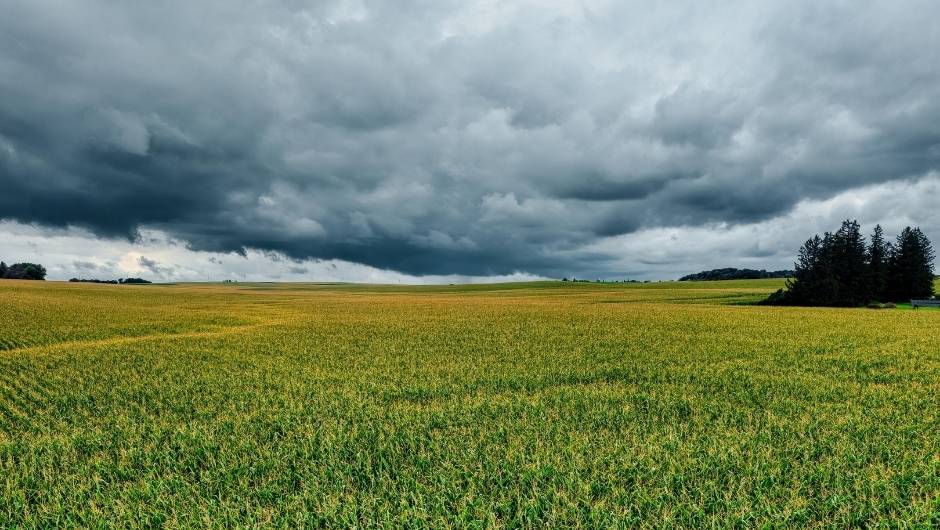
The National Institute of Meteorology's (Inmet) climate forecast for July 2026 indicates continued above-average rainfall in areas of the South and North regions, as well as above-average temperatures across much of the country. Conversely, some areas in the North, Northeast, and Southeast regions are expected to experience rainfall below the climatological average for the period.
In the Northern Region, the highest rainfall totals are expected only in Amapá and northwestern Pará. Meanwhile, in practically all of Amazonas and the far north of Roraima, the trend is for below-average rainfall.
In the Northeast, rainfall is expected to be below average along the coastal strip of the far south of Bahia and in areas of central and northeastern Pernambuco, as well as eastern Paraíba and Rio Grande do Norte. In other locations, rainfall amounts should be close to the climatological average.
For the Central-West region, rainfall is expected to be close to the historical average for July in most of the region, with the exception of north-central Mato Grosso do Sul, where accumulations tend to be below average.
In the Southeast region, Espírito Santo is expected to experience below-average rainfall during the month. Meanwhile, the far south of São Paulo could accumulate up to 50 millimeters above the climatological average, while other areas of the region should see volumes closer to the historical average.
In the Southern Region, the forecast maintains above-average rainfall in much of Rio Grande do Sul and Santa Catarina, as well as southeastern Paraná. In contrast, northern Paraná is expected to experience below-average rainfall, while the remaining areas of the region tend to remain close to the climatological average.
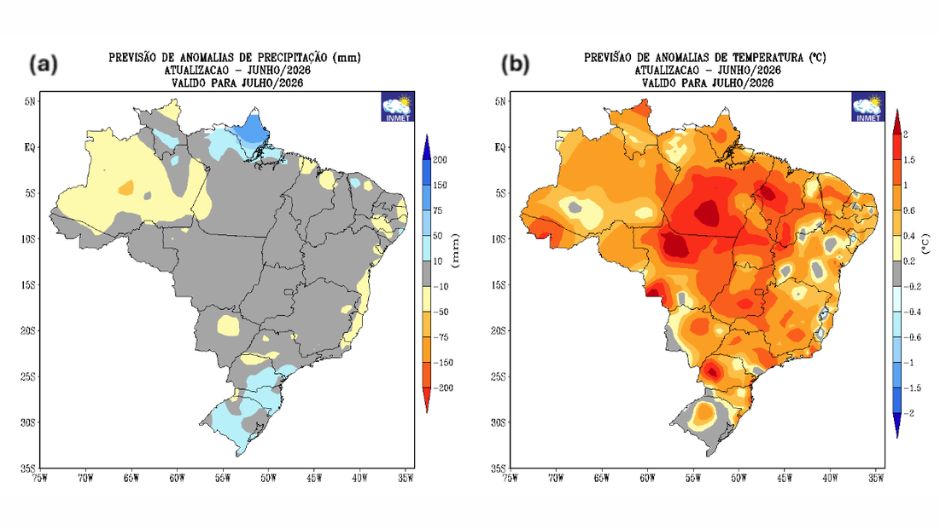
Regarding temperatures, Inmet predicts a predominance of above-average values in all regions of the country.
In the Northern Region, positive deviations should be around 1°C in most of the region. In north-central Pará and in large parts of Acre and Tocantins, the warming may be more intense, with anomalies exceeding 1,5°C, especially in the interior of Pará.
In the Northeast, temperatures are expected to exceed the average by more than 1°C in much of Maranhão and south-central Piauí. In other areas, deviations are expected to remain up to 1°C above the climatological average.
For the Central-West region, the largest positive deviations are expected in the northwest and southwest of Mato Grosso, where temperatures could be more than 2°C above the July average. In the rest of the region, the forecast is for values up to 1,5°C higher than the historical average.
In the Southeast, temperatures are predominantly up to 1°C above average, with more significant warming in western Minas Gerais, where deviations can exceed 1,5°C.
In the Southern Region, temperatures are expected to remain above average in the central-west of Paraná and in much of Santa Catarina. In Rio Grande do Sul, the trend is for values close to the climatological average, except for the central-west of the state, where thermometers may register up to 1 °C above the historical average for July.
In the Northern Region, the forecast of near-average rainfall across most of the territory, combined with above-average temperatures, should favor the progress and completion of the second-crop corn and bean harvest. In southeastern Pará and Tocantins, this scenario contributes to reducing grain moisture, extending harvesting operational windows, and helping to preserve the quality of the production.
Conversely, in northern Roraima and much of Amazonas, the combination of slightly below-average rainfall and higher temperatures tends to increase the evaporative demand of the atmosphere. As a consequence, there may be a reduction in soil moisture, impacting developing crops, pastures, and production systems more dependent on rainfall, as well as increasing the risk of hotspots.
In the Northeast, the forecast of average rainfall and above-normal temperatures favors cotton cultivation, which is mostly in the final phase of its cycle in western Bahia and in semi-arid areas. The warmer weather contributes to the opening of the bolls, reduces the incidence of diseases related to excess moisture, and extends the harvest window.
On the other hand, the third-crop bean fields, concentrated in the eastern part of the region and in the reproductive phase, require greater attention. High temperatures increase the plants' water demand and the risk of heat stress, which can compromise flowering, pod setting, and grain filling.
In the Midwest, the expectation of near-average rainfall, coupled with above-normal temperatures, should gradually reduce soil water storage, favoring conditions of water deficit, especially in Mato Grosso and Goiás.
During this period, a large portion of the second-crop corn and cotton fields are in the final stages of their cycle. Drier conditions tend to favor maturation and harvesting, reducing losses associated with excess moisture. For irrigated crops, such as wheat and beans, the increased water demand will require greater attention to irrigation management, especially during flowering and grain filling.
In the Southeast region, rainfall is expected to remain close to average across most of the area, with the exception of Espírito Santo, where volumes tend to be below normal, and the extreme south of São Paulo, which may register accumulations above the climatological average. Combined with high temperatures, these conditions favor increased evapotranspiration and water demand from crops.
Coffee, fruit trees, and vegetables require greater attention to irrigation management, especially in areas with lower soil water availability. In irrigated systems, high solar radiation favors crop development, particularly for beans grown in Minas Gerais, provided that the water supply is maintained adequately.
In the Southern Region, the forecast of rainfall near or above average, combined with higher temperatures in Paraná and Santa Catarina, favors the development of winter crops due to good water availability.
On the other hand, the higher frequency of rainfall, combined with high air humidity and heat, increases conditions favorable to the emergence of fungal diseases, requiring phytosanitary monitoring and the adoption of control measures. Above-average temperatures also reduce the likelihood of intense frosts, decreasing the risks for crops in sensitive stages, such as flowering and grain filling, especially in Paraná and Santa Catarina. In Rio Grande do Sul, where temperatures tend to remain close to the climatological average in most of the state, conditions remain favorable for the development of winter crops and pastures.
Receive the latest agriculture news by email


Receive the latest agriculture news by email