The mite Aponychus schultzi has been reported in chayote squash in Rio Grande do Sul
Occurrence expands the distribution of the association with Sechium edule and describes leaf lesions in Lajeado
12.09.2026 | 16:48 (UTC -3)
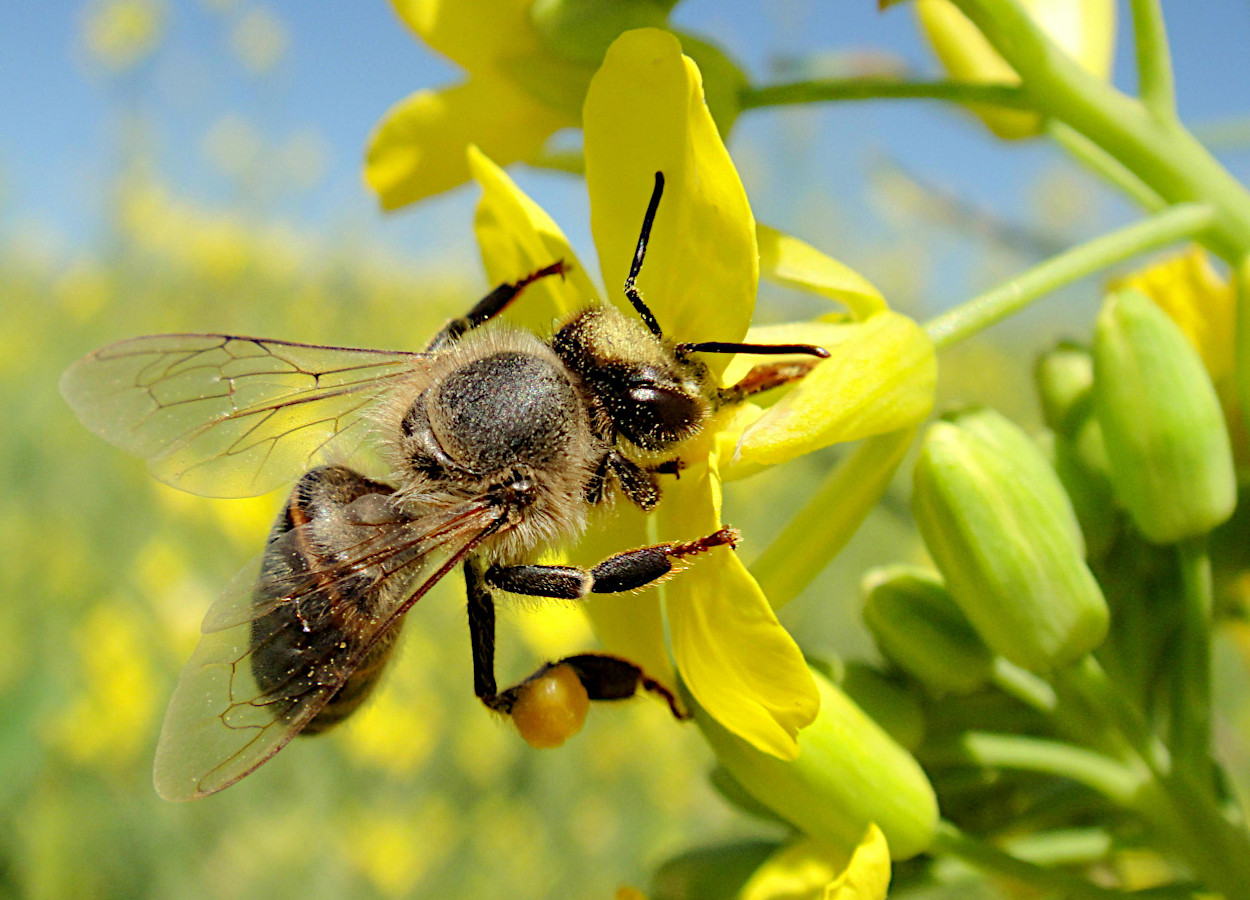
The higher density of honeybees (Apis mellifera) reduced the abundance of other floral visitors and increased the frequency of food disputes in areas of the United Kingdom. Researchers recorded chases, displacements, and avoidance behaviors during encounters over flowers. The observations point to interference competition as a relevant mechanism in the dispute between managed bees and other pollinators.
The study tracked visitors to Rubus fruticosus and Hedera helix. Both plants provide important resources during periods of lower availability of other flowers. Observations took place in Cambridgeshire, UK, during 2023 and 2024. The sites were located up to 300 meters from known Apis mellifera colonies. Researchers tracked 300 pairs of interactions over 93 hours (doi 10.1111/een.70139).
The team classified the outcome of each encounter according to access to the floral resource. An individual was classified as the winner when it managed to occupy the flower and caused the other visitor to lose a foraging opportunity. The scientists also recorded situations of sharing, when two insects used the resource without confrontation.
The presence of Apis mellifera showed a negative association with the abundance of other pollinators in both plant species. In Rubus fruticosus, the survey counted 1.789 floral visitors. Honeybees accounted for 57% of this total. Bumblebees represented 23%, hoverflies 11%, solitary bees 7%, and other visitors 2%. The higher density of Apis mellifera showed a significant relationship with a lower relative abundance of visitors not belonging to the genus Apis. The effect was stronger among bumblebees.
In Hedera helix, researchers recorded 2.232 visitors distributed across 30 taxonomic groups. Solitary bees comprised 41% of the total, predominantly Colletes hederae. Honeybees accounted for 27%. The increase in Apis mellifera density was accompanied by a reduction in the abundance of solitary bees and hoverbees. The number of floral units also influenced visitor abundance.
Researchers recorded 171 pairs of interactions during 43 hours of observation in Rubus fruticosus. Honeybees participated in 53,3% of the encounters. They gained access to the resource in 65,7% of the interactions in which disputes occurred. The win rate exceeded the expected value from statistical analysis. Solitary bees lost access to the resource in 61,5% of the encounters. Syrphid bees lost in 66,6%.
The frequency of disputes in Rubus fruticosus increased with the increase in density and number of visits by Apis mellifera. The study also found an influence of environmental variables. Temperature and humidity showed a positive association with competitive interactions in some analyses. Higher wind speeds were associated with a lower number of disputes.
The observed behaviors reinforced the hypothesis of interference competition. In Rubus fruticosus, other visitors avoided honeybees in 28,4% of the victories recorded for Apis mellifera. Physical displacement of the other visitor occurred in 20,1% of the victories. Chases appeared in 6,1%. In 14 episodes with chases, the honeybee initiated the action in 80% of the cases.
The pattern also appeared in Hedera helix. The survey totaled 129 interactions over 50 hours. Honeybees achieved the highest number of competitive victories and occupied the resource in 50,6% of encounters. Other visitors avoided Apis mellifera in 35,6% of the species' victories. Displacements accounted for 15% and chases for 5,5%.
Hoverflies showed greater vulnerability in encounters. In interactions with honeybees on Hedera helix, half of the hoverflies avoided the bee, 44% were displaced, and 6% were chased. In all interactions on this plant, the group lost the resource in 60,4% of cases. The analysis of behaviors also indicated a significant association between the pollinator group and the type of interaction. Displacements and chases by Apis mellifera made an important contribution to this result.
Not all solitary bees exhibited the same pattern in the presence of Apis mellifera. In Hedera helix, Colletes hederae individuals managed to obtain the resource in some encounters with honeybees. When Apis mellifera previously occupied the flower and a solitary bee arrived at the location, the group of solitary bees won more frequently than the honeybee. The researchers point to the need for further studies on characteristics of Colletes hederae capable of reducing the effects of interference competition.
The study differentiates this process from exploitative competition. In exploitative competition, a visitor consumes nectar or pollen and reduces its availability for other insects. In interference competition, the interaction occurs directly. A visitor drives away, displaces, or prevents another from accessing the resource. The results indicate the participation of both mechanisms, but highlight a possibly underestimated importance of interference in pollinator communities.
Scientists emphasize that the observations focused on two plant species and interactions at the floral patch scale. The work did not assess long-term population effects. The team proposes further studies on other resources, including cultivated areas, as well as the analysis of environmental and landscape factors. According to the researchers, a more detailed understanding of interference competition could support measures aimed at reducing the effects of high honeybee densities on other pollinators.
Receive the latest agriculture news by email


Receive the latest agriculture news by email