El Niño requires strategic management in the 2026/27 harvest
This phenomenon is expected to increase disease pressure in soybeans, corn, and wheat, and will require phytosanitary planning.
14.07.2026 | 16:49 (UTC -3)

According to crop monitoring carried out by the National Supply Company (Conab), wheat sowing in the country has already reached 94,7% of the planned area. In Rio Grande do Sul, sowing work has reached, on average, 87% of the estimated area, with a predominance of crops in the initial vegetative development and tillering stages.
In Paraná, the high rainfall volumes recorded at the beginning of July in the western and southwestern regions increased phytosanitary pressure, favoring the occurrence of fungal diseases and leaf spots. In Santa Catarina, the dry weather has contributed to improved operational conditions, favoring wheat germination and emergence.
In these states, crops are predominantly between the vegetative and reproductive phases, a period in which there is an increased demand for water due to intense plant growth. As a consequence, crops become more sensitive to water deficits.
So far, crop development has been favored by regular rainfall and milder temperatures in the region. The municipality of Cruz Alta (RS) exemplifies the prevailing weather conditions during crop development in the northwestern region of Rio Grande do Sul.
Rainfall was regular during the first half of the period, with the highest accumulations recorded on 6/29 (19,9 mm), 7/2 (15,2 mm), 6/22 (14,9 mm), 6/28 (12,6 mm), and 06/19 (11,9 mm). From the beginning of July, a reduction in rainfall was observed, resulting in a prolonged dry period, with volumes close to zero until 07/13.
Maximum temperatures ranged between 8,9 °C and 23,0 °C, while minimum temperatures showed greater variation, especially on June 16th, July 4th, and July 7th, when the lowest values of the period were recorded, at 2,0 °C and 0,2 °C, respectively. According to Emater/RS, the low temperatures and the occurrence of light frosts favored plant tillering, without causing significant damage to the region's crops.
For the next five days, the forecast indicates a gradual increase in temperatures. From July 15th, maximum temperatures are expected to rise progressively, exceeding 27°C between July 17th and 18th, while the weather should remain stable until Saturday (July 18th). This scenario of gradual warming, associated with the low probability of rain in the short term, reinforces the need to monitor soil moisture, especially due to the increased water demand of crops during this development phase.

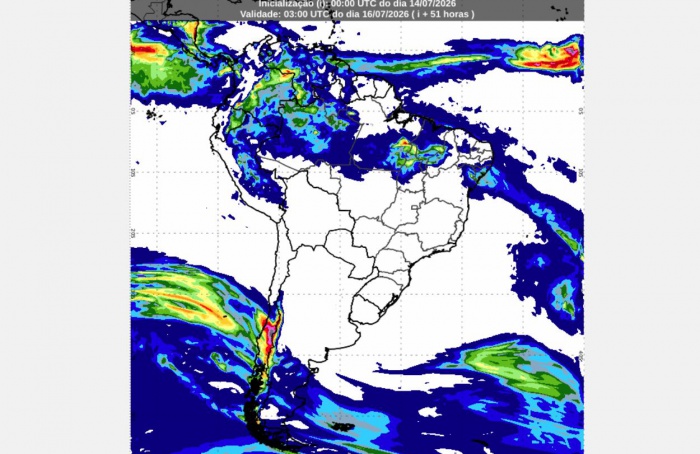
However, concern is growing given the forecast for the next fifteen days, which indicates the development of a low-pressure area over Argentina, associated with the transport of warm, humid air by the Low-Level Jet (LLJ). At the beginning of the week, this configuration should favor the return of rain to much of Rio Grande do Sul and the extreme south of Santa Catarina, where accumulated volumes could exceed 150 mm. This scenario increases the potential for storm formation, which is why Inmet (National Institute of Meteorology) issued an orange-level storm warning, valid for Friday and Saturday, for much of Rio Grande do Sul. In other areas of the Southern Region, the weather should remain stable.
The high rainfall volumes predicted tend to hinder management operations such as topdressing fertilization, pesticide application, and machinery traffic, in addition to increasing the likelihood of fungal diseases, especially in areas with long periods of leaf wetness and high relative humidity. These effects can compromise both crop development and the efficiency of management practices adopted during this period.
The impacts also extend to livestock farming. Heavy rains can reduce pasture quality, hinder herd management, and increase the risk of health problems associated with excess moisture in the environment. In areas prone to flooding, there is also potential for losses of rural infrastructure, damage to rural roads, and difficulties in transporting inputs and agricultural production.
Therefore, although rainfall contributes to replenishing soil moisture and recovering water reserves, very high volumes concentrated in a few days tend to increase the risk of negative impacts on agriculture in Rio Grande do Sul, mainly due to soil saturation, interruption of field operations, and greater susceptibility to diseases in winter crops. In this context, continuous monitoring of crop conditions and the adoption of management practices at the appropriate time become fundamental in order to mitigate phytosanitary risks and preserve the productive potential of wheat cultivation in the region.

Receive the latest agriculture news by email


Receive the latest agriculture news by email