American study indicates lower soybean production costs in Brazil
Research indicates lower total cost in the country, despite higher spending on fertilizers and pesticides
02.11.2026 | 16:26 (UTC -3)
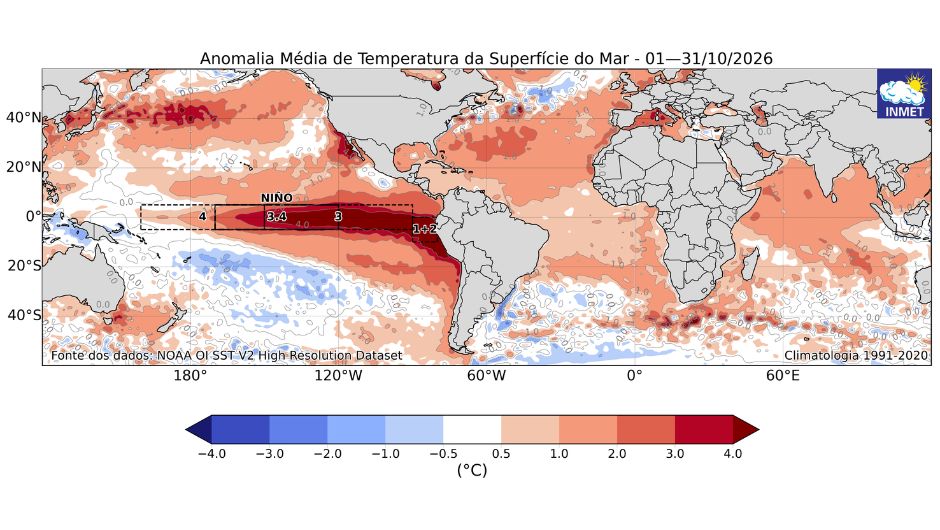
The 2026 El Niño recorded the largest sea surface temperature (SST) anomaly ever observed for that month in the Niño 3.4 region in October, according to the National Institute of Meteorology (Inmet). The positive deviation reached 2,47 °C compared to the historical average, characterizing a very strong episode of the phenomenon.
In the Niño 3 region, which also influences the climate patterns of South America, the monthly anomaly reached 3,56 °C.
Warming also progressed in weekly measurements. In the last week of October, the Niño 3.4 region recorded an anomaly of 2,5 °C. According to meteorologist Leydson Dantas, comparing monthly and weekly indicators requires caution, as they consider different reference periods.
Until then, the highest monthly value for October had been recorded during the 1982 El Niño, when the anomaly reached 2,07 °C. That episode was one of the most intense ever observed and extended into the first half of 1983.
The weekly data, whose historical series begins in 1981, also indicate extreme values in other monitoring areas of the Equatorial Pacific.
In the Niño 1+2 region, near the coasts of Peru and Ecuador, the anomaly reached 4,6 °C in the last week of October, matching the record registered in June 1983.
In the Niño 3 region, the positive deviation reached 3,7 °C, surpassing the previous record of 3,6 °C, observed in December 1982.
The Niño regions are used to monitor the El Niño–Southern Oscillation (ENSO) phenomenon, which includes El Niño and La Niña episodes and periods of neutrality. The Niño 3.4 region is one of the main references for characterizing these events, while Niño 3 is also relevant for assessing its relationship with climate variability in South America.
The 2026 El Niño began to take shape in June and showed accelerated warming in the following months. According to the World Meteorological Organization (WMO), the event has the potential to be among the most intense ever recorded.
The phenomenon is characterized by the abnormal warming of the surface waters of the Equatorial Pacific, which alters atmospheric circulation and modifies rainfall and temperature patterns in different regions of the planet.
In Brazil, the effects vary depending on the intensity of the event, the time of year, and regional atmospheric conditions. Therefore, monitoring ocean temperatures and the evolution of the phenomenon is important to assess potential impacts on the climate in the coming weeks.
Receive the latest agriculture news by email



Receive the latest agriculture news by email