Mosaic reports a loss of US$72 million in the third quarter
The result contrasts with a profit of US$411 million in 2025; Brazilian operations register a drop in sales
03.11.2026 | 19:01 (UTC -3)
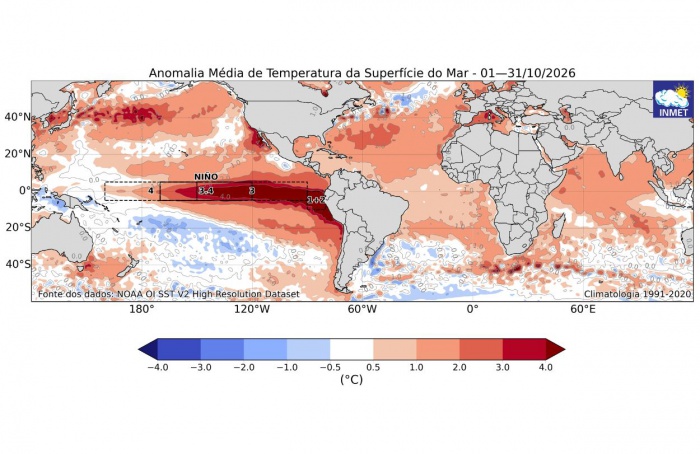
The El Niño phenomenon is intensifying in the Equatorial Pacific Ocean. According to the Climate Prediction Center (CPC) of the United States National Oceanic and Atmospheric Administration (NOAA), the sea surface temperature anomaly in the Niño 3.4 region reached +2,47 °C in October 2026.
According to the update released by the CPC on October 8th, the forecast is that the phenomenon will remain in the strong to very strong categories until the January-February-March 2027 quarter. Projections indicate an 83% probability that the current episode will surpass, in intensity, the El Niño events recorded since 1950 during the October-November-December 2026 quarter.
In Matopiba, a region encompassing agricultural areas of Maranhão, Tocantins, Piauí, and Bahia, September and October mark the transition between the dry season and the beginning of the rainy season. During this phase, the advance of unstable weather patterns favors the regularization of rainfall, essential for restoring soil moisture and allowing the planting of the new crop, especially soybeans.
According to the National Institute of Meteorology (Inmet), September 2026 recorded low rainfall volumes and irregular distribution of precipitation, insufficient to promote significant changes in soil water storage. The highest accumulations occurred in western and northern Tocantins and southern Bahia. In much of the region, the combination of scarce rainfall and high temperatures contributed to maintaining the water deficit.
Average maximum temperatures were also above the climatological average in several areas of Matopiba. Data from Inmet meteorological stations indicated anomalies greater than 2 °C in September, notably in Jacobina (BA), where the deviation reached +3,0 °C, and Morro do Chapéu (BA), with +3,6 °C compared to the climatological average.
The heat, combined with irregular rainfall, increases the environment's water demand and water losses through evaporation. Under these conditions, higher rainfall volumes are needed to replenish soil moisture and ensure adequate water availability for sowing and the initial development of soybeans.
In October, the behavior of maximum temperatures remained similar to the previous month. Several locations recorded anomalies greater than 2 °C, reaching approximately 3 °C. Cruz das Almas (BA) showed a deviation of +3,0 °C, while Araguaína (TO) recorded +3,2 °C in relation to the climatological normal from 1991 to 2020. The high temperatures continued to intensify water demand and limit the effects of rainfall on soil moisture recovery.
The situation demands particular attention in irrigated soybean growing areas in western Bahia. In this region, monitoring water availability and adjusting irrigation management to crop demand are important to ensure adequate conditions during crop emergence and establishment.
Despite the observed restrictions, there was an advance of unstable areas, mainly over the southern part of Matopiba, including locations in Tocantins and Bahia. The comparison between September and October indicates an increase in soil water availability, especially in Tocantins, where levels exceeded 30% in some areas. Although the recovery is still partial, the data highlight the contribution of rainfall to the improvement of regional water conditions.
The weather conditions observed at the beginning of the cycle are crucial for the progress of sowing and the establishment of crops. To contextualize the possible effects of El Niño on the current harvest, the historical series of soybean productivity in Matopiba between 1996 and 2025 was analyzed.
The results show that the crop's response to the phenomenon does not follow a uniform pattern across states. In Bahia and Piauí, 50% of the years under El Niño influence showed productivity above the historical average, indicating a higher frequency of favorable results. In Tocantins, there was a balanced distribution between productivity at and above the average, both with a frequency of 37,5%. In Maranhão, yields close to the historical average predominated, observed in 50% of cases.
Despite these trends, all states recorded years with below-average productivity, with frequencies ranging from 25% to 37,5%. Piauí showed the greatest variability, combining both the highest proportion of years with above-average income (50%) and a significant frequency of below-average results (37,5%).
In general, the data indicate that the occurrence of El Niño is not necessarily associated with reduced soybean productivity in Matopiba. The intensity and direction of its effects depend primarily on the distribution of rainfall throughout the crop cycle. Periods of water deficit coinciding with more sensitive phenological stages, such as flowering and grain filling, can compromise yield.
Historical analysis helps to contextualize the scenario for the 2026/2027 harvest. The irregular distribution of rainfall, the partial recovery of soil moisture in some areas, and the persistence of temperatures above the climatological average occur during a strategic period for crop establishment.
To date, the potential impacts are mainly related to crop establishment, affecting planting progress, emergence uniformity, and plant stand formation. Although limitations at this stage may reduce the productive potential of certain areas, there is still insufficient data to determine the final crop performance.
Yield will depend mainly on the evolution of water and temperature conditions in the coming months, especially during the reproductive stages, when water demand increases and soybeans become more sensitive to environmental stresses.
Thus, the evolution of rainfall and temperatures will be crucial in assessing whether the harvest will behave similarly to what is observed in El Niño years, with average or above-average yields in Matopiba, or whether the water restrictions and excessive heat recorded at the beginning of the cycle will persist until the critical stages of the crop.
In this scenario, monitoring weather conditions and soil moisture will be fundamental to guiding agricultural management and planning, allowing for risk reduction and adapting decisions to climatic conditions throughout the growing season.
Receive the latest agriculture news by email



Receive the latest agriculture news by email