RS Harvest 2025/26: Wheat sowing advances to 87%
Emater/RS indicates that crop planting is nearing completion in the state.
09.07.2026 | 17:33 (UTC -3)
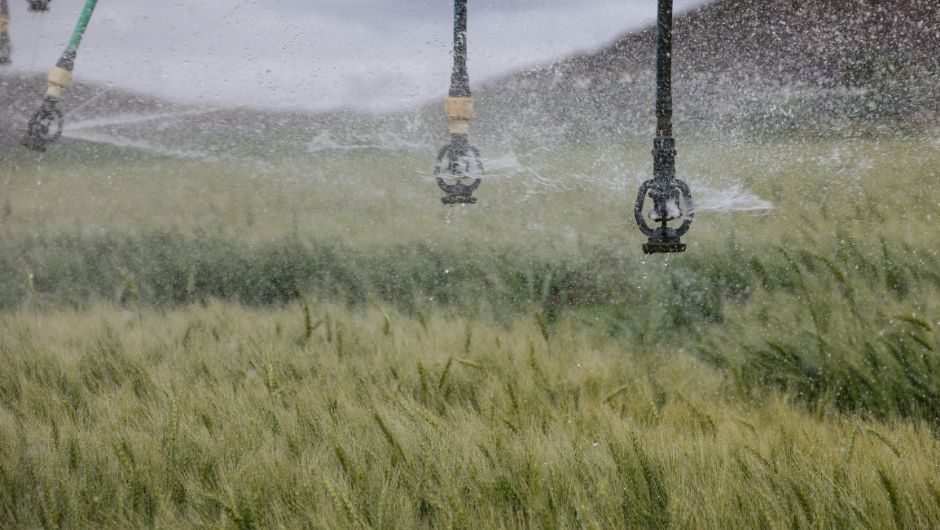
According to crop monitoring carried out by the National Supply Company (Conab), irrigated wheat areas in Goiás are showing good development, with most crops in the flowering stage. In Minas Gerais, the first week of July was marked by stable weather and a lack of rain, favoring the progress of the second-crop bean harvest. Approximately 90% of the cultivated area has already been harvested, while the remaining crops are in full maturation, undergoing desiccation and natural drying of the grains for the imminent harvest.
In this context, monitoring phenological development through thermal summation (degree-days) is an important tool for tracking crop evolution. Unlike the exclusive use of the agricultural calendar, this methodology considers the accumulation of thermal energy necessary for plants to advance through different phenological stages, providing more representative estimates of crop development under different environmental conditions.
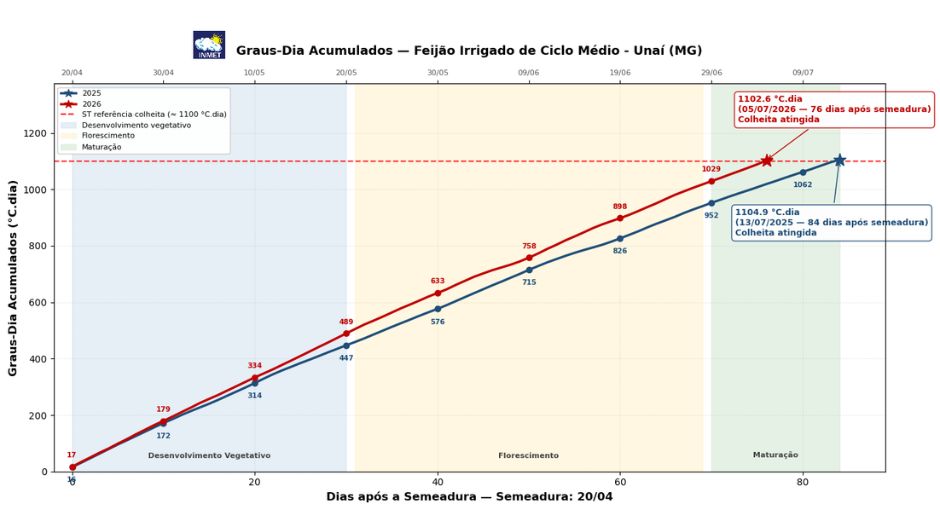
As an example of the application of this methodology, simulations were carried out using the Agricultural Decision Support System (Sisdagro), developed by the National Institute of Meteorology (Imet), for two important producing regions of the Brazilian Cerrado. The analyses considered medium-cycle irrigated wheat in Cristalina (GO), sown on April 15, and medium-cycle irrigated beans in Unaí (MG), sown on April 20, comparing the 2025 and 2026 harvests.
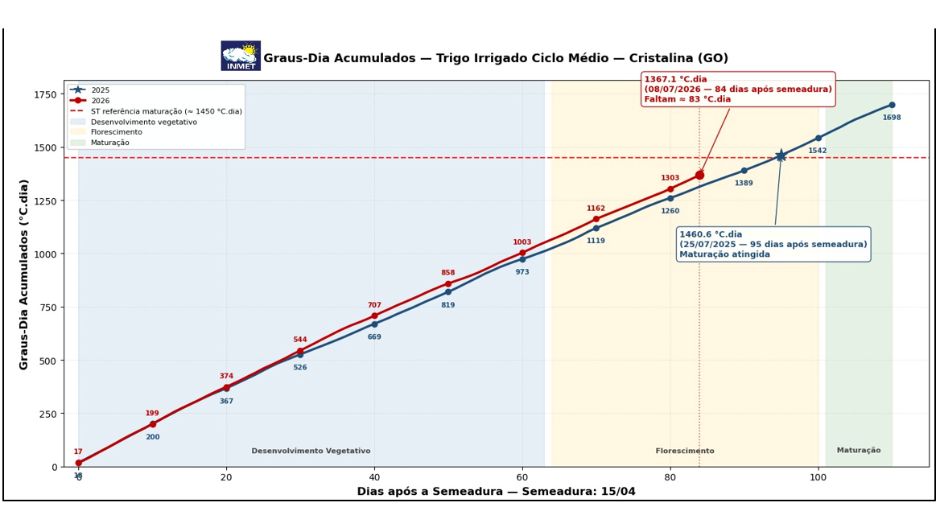
In both evaluated growing seasons, the crop showed similar behavior during vegetative development; however, in 2026, the accumulation of degree-days occurred at a slightly higher rate than that observed in 2025. At 60 days after sowing, the crop accumulated approximately 1.003 °C.days, while, in the same period of the previous growing season, approximately 973 °C.days had been recorded.
In the 2025 growing season, wheat reached the reference thermal sum for crop maturity (1.450 °C.day) 95 days after sowing, accumulating 1.460,6 °C.day on July 25th. In 2026, up to July 8th, 1.367,1 °C.day had been accumulated 84 days after sowing, leaving approximately 83 °C.day to reach this threshold. Field observations corroborate these results.
Unlike what was observed for wheat, beans showed superior thermal accumulation throughout almost the entire cycle in 2026. As a consequence, the reference thermal sum for crop maturation (1.100 °C.day) was reached 76 days after sowing, when the crop accumulated 1.102,6 °C.day on July 5th. In the 2025 crop, this same threshold was reached only 84 days after sowing, registering 1.104,9 °C.day on July 13th.
The simulations therefore indicate an approximate reduction of eight days in the duration of the irrigated bean crop cycle compared to the previous harvest. This behavior is consistent with what has been observed in the field. In Minas Gerais, the dry weather favored the progress of the second-crop bean harvest, which has already reached approximately 90% of the cultivated area. The remaining crops are in full maturation, undergoing desiccation and natural drying of the grains for the imminent harvest. The results demonstrate the potential of degree-day monitoring to track the phenological evolution of crops and support decisions related to management, irrigation, and harvest planning.
The Inmet forecast for the next seven days indicates predominantly dry weather over Goiás and much of Minas Gerais, with no significant rainfall in the regions of Cristalina (GO) and Unaí (MG). Accumulated precipitation is expected to be concentrated only in areas of southern, southwestern, and Zona da Mata regions of Minas Gerais, with volumes between 3 and 10 mm, insufficient to alter the prevailing conditions in the main producing regions evaluated. In Cristalina (GO), maximum temperatures should range between 26°C and 29°C, with minimum temperatures between 16°C and 20°C. In Unaí (MG), maximum temperatures should remain between 29°C and 32°C, while minimum temperatures should oscillate between 16°C and 18°C.
These weather conditions tend to favor the continued development of irrigated wheat and the advancement of maturation and harvesting of second-crop beans, contributing to maintaining grain quality and the smooth running of field operations. Continuous monitoring of weather forecasts remains important to guide crop management and the planning of agricultural activities.
Receive the latest agriculture news by email


Receive the latest agriculture news by email