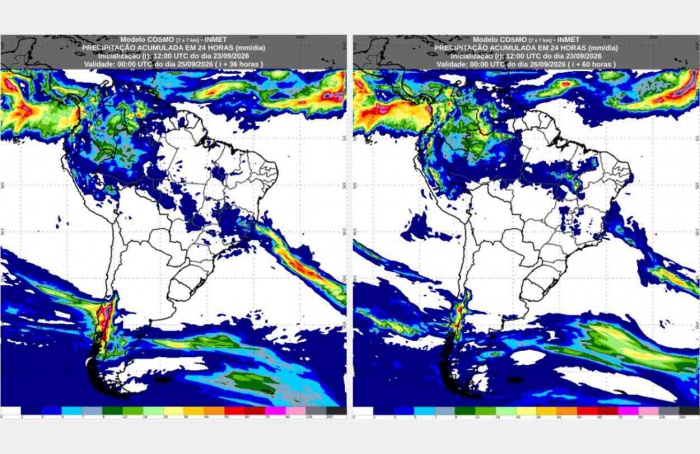
Excessive rainfall challenges planting of the 2026/27 crop in Rio Grande do Sul.
Copaaergs forecasts above-average rainfall between October and December and warns of reduced management windows.
23.09.2026 | 17:20 (UTC -3)

Brazilian coffee production in 2026 is estimated at 67,6 million 60-kilo bags, according to the third survey by the National Supply Company (Conab), released this Thursday (September 24). This volume represents a 19,6% increase compared to the 2025 harvest and, if confirmed, will be the largest ever recorded in the company's historical series.
With 99% of the area harvested, the result is mainly attributed to the combination of the positive biennial cycle, the increase in the area under production, and the rise in average national productivity. The productive area should reach 1,95 million hectares, an increase of 5,1% over the previous cycle. Productivity is estimated at 34,6 sacks per hectare, compared to 30,4 sacks per hectare in 2025, an increase of 13,8%.
According to Conab, in addition to the physiological characteristics of the plants in a year of positive biennial bearing, especially in Arabica coffee, crop performance was favored by the greater use of management technologies and by more favorable climatic conditions in important producing regions.
Arabica coffee is expected to account for 48,2 million bags of Brazilian production in 2026, a 34,8% increase compared to the volume harvested last year. This variety represents about 70% of national production.
Minas Gerais accounts for the largest share of this volume, with an estimated 34,96 million bags of Arabica coffee. In the South and Central-West regions of the state, production is expected to reach 15,93 million bags.
Conab attributes Minas Gerais' performance to the positive biennial cycle and the distribution of rainfall in the months leading up to flowering. Favorable weather conditions until March also contributed to fruit development and increased productivity.
In São Paulo, Arabica coffee production is estimated at 6,19 million bags. According to the company, regular rainfall following periods of drought, mild temperatures, and the absence of excessive heat have favored the development of coffee plantations and increased productivity in the interior of São Paulo state.
For Robusta coffee, the estimate is 19,4 million bags, a 6,6% decrease compared to 2025. The area under production, on the other hand, is expected to grow by 4%, reaching 386,6 hectares.
The decline in production is mainly related to reduced productivity, influenced by crop performance in Espírito Santo, the main producing state of this species.
In the state, total coffee production is expected to fall 5,4%, to 16,48 million bags. Robusta production is estimated at 12,1 million bags, a 14,3% reduction compared to the previous harvest. According to Conab, the irregular flowering was caused by the low temperatures recorded in the producing region.
The scenario is different for Arabica coffee from Espírito Santo. Production is expected to grow by 33%, to 4,38 million bags, favored by climatic conditions, a 4,9% increase in the area under production, and a positive biennial cycle.
In Bahia, total coffee production is expected to grow by 1,2%. The company attributes this result to consistent weather conditions, investments in inputs, and the entry of new areas into production. Of the estimated volume for the state, 1,19 million bags correspond to Arabica and 3,3 million to Robusta.
In Rondônia, where cultivation is concentrated on conilon coffee, the harvest is practically complete. With 98% of the productive areas harvested by the end of August, Conab estimates a production of 2,88 million bags, a 24% increase over 2025.
The company highlights that the weather conditions, especially the regularity of the rainfall, favored the formation of the beans and contributed to the quality and yield of the production. The result is also associated with the use of management technologies by coffee growers.
Despite expectations of a record harvest, export performance has shown distinct trends throughout the year.
In August, Brazil exported 3,8 million 60-kilogram bags of coffee, according to data from the Ministry of Development, Industry, Trade and Services (MDIC). This volume was 25,8% higher than that recorded in July and 43,2% higher than in August 2025, representing the highest result for the month in the historical series.
However, in the period from January to August, exports totaled 24,6 million bags, a decrease of 6,6% compared to the same period in 2025.
For the 2026/27 crop year, the United States Department of Agriculture (USDA) estimates a record global production of 189,7 million 60-kilogram bags, a 6,1% increase compared to the previous season.
Global consumption is also expected to grow, reaching 179,7 million bags, an increase of 3,6%. Demand should remain high in both traditional markets, such as Europe, the United States and Brazil, and in expanding markets, such as China.
According to the analysis presented by Conab, international coffee prices are under pressure with the entry of the Brazilian harvest into the market, the proximity of the harvest in Vietnam, and the seasonal increase in Colombian production expected for the last quarter of the year.
The recovery in supply in these countries reduces some concerns about product availability. On the other hand, inventories are still at low levels and global demand continues to grow, factors that may limit a sharper drop in prices. Forecasts of El Niño events during the 2026/27 cycle also remain a factor of concern for production in various countries.
Receive the latest agriculture news by email



Receive the latest agriculture news by email