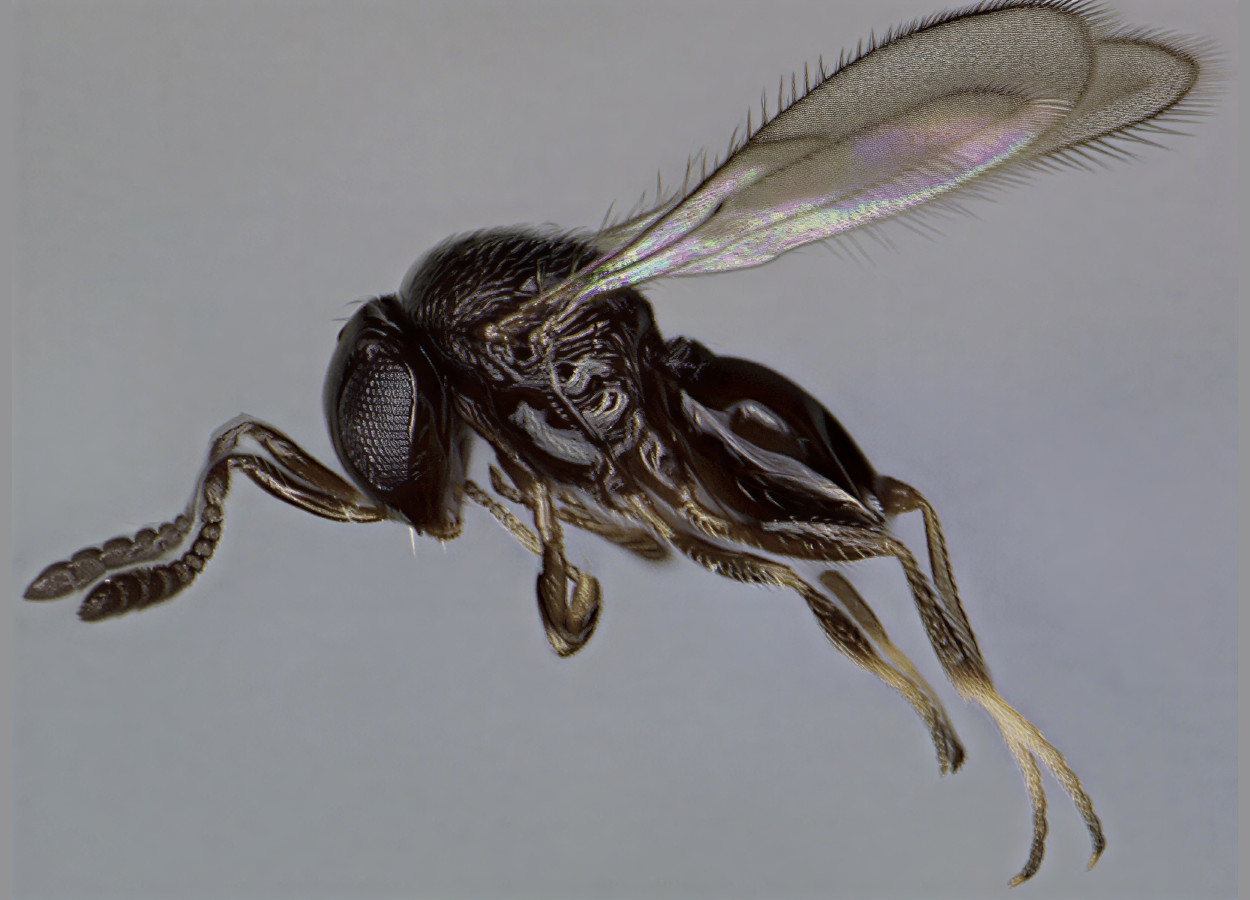
Chemical compounds guide parasitoid to fall armyworm eggs.
Study identifies volatile signals responsible for Telenomus remus's preference.
16.03.2026 | 14:54 (UTC -3)
Schubert Peter, Cultivar Magazine
Foto: doi.org/10.1038/s41598-021-93510-3
Researchers have identified chemical compounds present on the surface of eggs from fall armyworm (Spodoptera frugiperda) capable of guiding the parasitoid Telenomus remus During the search for hosts, the work revealed molecules with an attractive or repellent effect on the natural enemy and paves the way for biological control technologies based on semiochemicals.
Behavioral experiments indicated a strong preference of the parasitoid for Spodoptera frugiperda eggs compared to eggs of other species. In Y-shaped olfactometer tests, females of Telenomus remus They chose eggs of the pest more frequently than eggs of... Spodoptera litura, Spodoptera exigua and of the non-host species Ostrinia furnacalis.
The order of preference observed followed the pattern: Spodoptera frugiperda > Spodoptera exigua - Spodoptera litura > Ostrinia furnacalis.
Gas chromatography
The team used metabolomics based on gas chromatography coupled with mass spectrometry (GC-MS) to identify volatile compounds present in the eggs. The analysis detected 758 metabolites distributed across 11 chemical classes. Aldehydes, ketones, and esters concentrated the largest proportion, followed by hydrocarbons, alcohols, and amines.
Comparison between host and non-host eggs revealed compounds associated with parasitoid recognition. Among them, the cyclanalkane trans-1,2-dimethylcyclohexane showed a significant attractive effect for Telenomus remusThe compound appears at higher levels in the eggs of species in the Noctuidae family and may act as a chemical marker for suitable hosts.
Another compound, 2-heptadecanone, showed strong attraction at concentrations between 0,1 and 1 mg/mL. The substance occurs at high levels specifically in the eggs of Spodoptera frugiperdaThe result indicates a role in the selection of the preferred host during foraging. Telenomus remus.
Opposite effect
The study also identified molecules with the opposite effect. 2-hexanol alcohol caused significant repulsion of the parasitoid at all concentrations tested. Indole, on the other hand, did not trigger a relevant behavioral response in [concentration]. Telenomus remus.
The authors suggest a hierarchical relationship between chemical signals. Trans-1,2-dimethylcyclohexane would indicate the presence of noctuid moth eggs. 2-heptadecanone would reinforce specific identification of... Spodoptera frugiperdaThe combination would form a "chemical signature" capable of guiding Telenomus remus ...to the ideal host.
Further information at doi.org/10.3390/insects17030321