




Daniel Glat and Fábio Ruggiero leave SEEDCORP HO
Change takes place from January 1st; replacements have not yet been announced
09.12.2022 | 16:57 (UTC -3)
According to data from the monthly statistical report of the Brazilian Coffee Exporters Council (Cecafé), national shipments of the product totaled 3,673 million 60 kg bags in November, a volume that implies growth of 14,2% in relation to the 3,216 million sent to the abroad in the same month of 2021. Foreign exchange revenue jumped 39,9% in the same comparative interval, rising from US$632,5 million to the current US$885,2 million, a historic record for November.
With this performance, coffee exports from Brazil, in the first five months of the 2022/23 harvest year, rose to 16,051 million bags, becoming positive by 1,7% compared to the 15,784 million sent abroad between July and the end of November of the previous cycle.
When analyzing the financial income obtained from shipments, the second best performance in history is observed, behind only the same period in the 2011/12 season, with revenue reaching US$ 3,847 billion and showing an increase of 43,6% compared to identical previous interval.
Günter Häusler, president of Cecafé, assesses that the increase that occurred reflects global consumption that remains heated and the search by large importers for coffee from Brazil, despite the obstacles that continue to impact global maritime trade.
"The logistics scenario has been evolving gradually in recent months, allowing the country to achieve this result in November. However, it is important to highlight that there are still major challenges and that we are far from normality. On the other hand, demand remains and Large consumers continue to seek, from the largest producer and exporter in the world, the quality and diversity of our products, which respect socio-environmental criteria and meet the sustainability requirements of international markets, making Brazil a loyal supplier", he comments.
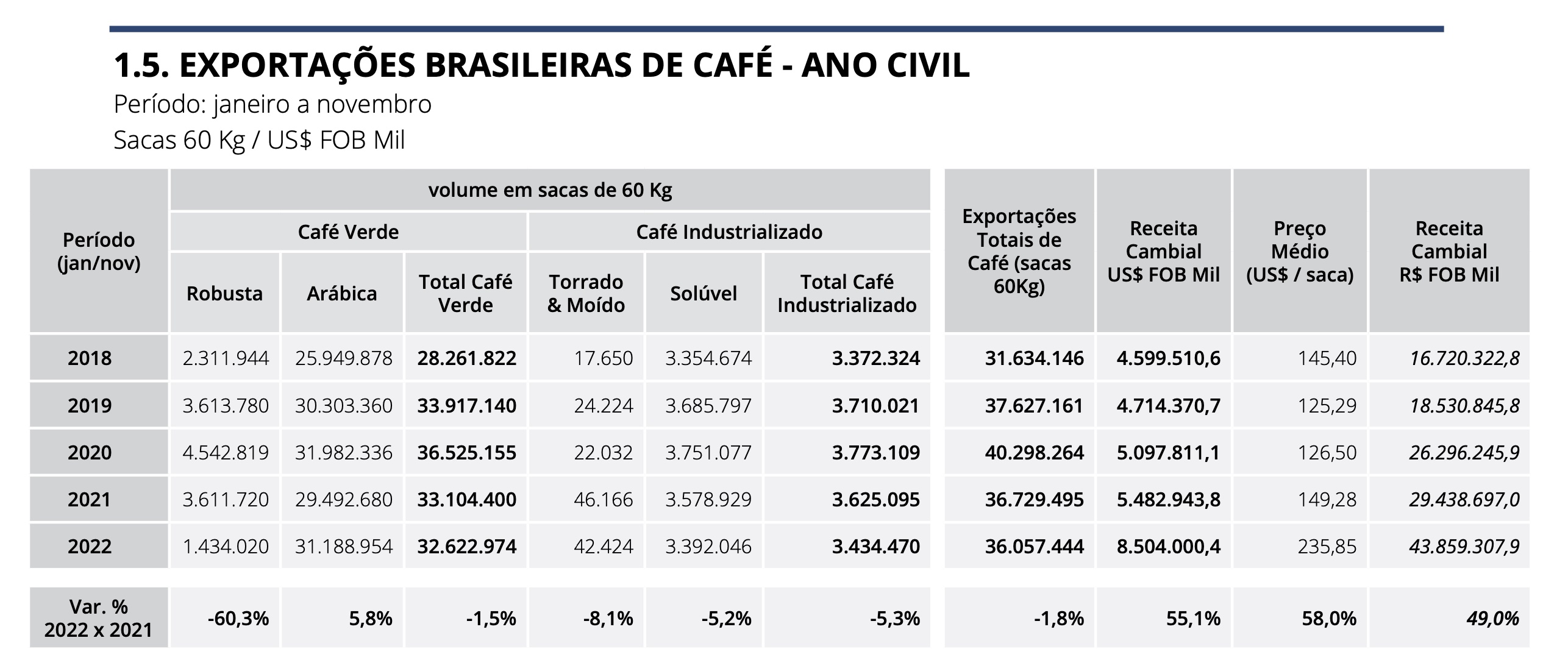
From January to the end of November this year, Brazil exported 36,057 million bags, an annual drop of 1,8%. The foreign exchange revenue, of US$ 8,504 billion, is a historical record for the period, registers substantial growth of 55,1% in relation to the US$ 5,483 billion obtained in the same period of 2021 and already surpasses the total inflows achieved throughout last year.
"In the balance of the year so far, we have better observed the impact of logistical bottlenecks on the volume of exports, which are slightly lower than last year. This performance also reflects the strong demand from the national industry for canephora coffees, which remain more competitive than Arabicas to Brazilian manufacturers, so much so that shipments of conilon and Robusta abroad fell by 60% from January to November", analyzes Häusler.
Regarding the record revenue, he explains that it results from the better level of prices observed this year, despite the recent falls in international markets, and the favorable exchange rate. "The average price of a bag of coffee exported by Brazil, in 2022, is US$235,85, 58% above the average value observed in 2021, for example", he adds.
Exemplifying the search by large global importers for Brazilian coffees cited by the president of Cecafé, nine of the country's 10 main trading partners increased their purchases. The United States tops the list of the product's biggest destinations between January and November, with imports of 7,351 million bags, an amount 3,3% higher than that obtained in the same period in 2021 and equivalent to 20,4% of the total.
Germany, with the acquisition of 6,331 million bags, increased its purchases of coffee from Brazil by 4,4% until November and represents 17,6% overall. Next comes Italy, with 3,110 million (+18,6% / 8,6% of the total); Belgium, with 2,760 million bags (+11,8% / 7,7% of the total); and Japan, with imports of 1,699 million bags (-24,4% / 4,7% of the total).
Shipments also increased for countries in sixth to 10th place in this ranking. Colombia, in sixth place, increased its purchases of the product by 52,5%, totaling 1,605 million bags, followed, respectively, by Spain, with an increase of 16,8%; Türkiye, with an increase of 0,2%; Netherlands (Netherlands), with a significant increase of 82,3%; and South Korea, with growth of 29,2%.
Arabica coffee continues to be the most exported this year, with 31,189 million bags shipped abroad, or 86,5% of the total. Instant coffee registered shipments equivalent to 3,392 million bags, accounting for 9,4%. Next comes the canephora variety (robusta + conilon), with exports of 1,434 million bags (4%), and the roasted and roasted and ground product, with 42.424 bags (0,1%).
Differentiated coffees, which have superior quality or some type of certificate of sustainable practices, accounted for 17,5% of total Brazilian exports of the product between January and November 2022, with 6,324 million bags shipped abroad. This volume represents a drop of 9,4% compared to the 6,981 million bags shipped by the country in the same period of the previous year.
The average price of the differentiated product was US$282,89 per bag, providing revenue of US$1,789 billion in the 11 months, which corresponds to 21% of that obtained from total shipments. In the annual comparison, the value is 42,4% higher than that recorded in the same previous interval.
In the ranking of the main destinations for differentiated coffees from January to November this year, the United States is at the top, with imports of 1,520 million bags, equivalent to 24% of the total of this type of product exported. Next comes Germany, with 1,097 million bags and a representation of 17,3%; Belgium, with 811.104 bags (12,8%); Italy, with 394.358 bags (6,2%); and Japan, with 291.271 bags (4,6%).
The Santos (SP) maritime complex remains the main exporter of coffee from Brazil in 2022, with the shipment of 29,095 million bags, which is equivalent to 80,7% of the total. Completing the list of the first three are the ports of Rio de Janeiro, which account for 14,9% of shipments, with the shipment of 5,357 million bags in the first 11 months of 2022, and Paranaguá (PR), with the export of 327.932 bags (0,9%).
Receive the latest agriculture news by email


Receive the latest agriculture news by email