External risks increase volatility for agricultural commodities
Rabobank forecasts rising oil prices, exchange rate uncertainty, and a slowdown in the Brazilian economy in 2026
25.08.2026 | 17:57 (UTC -3)
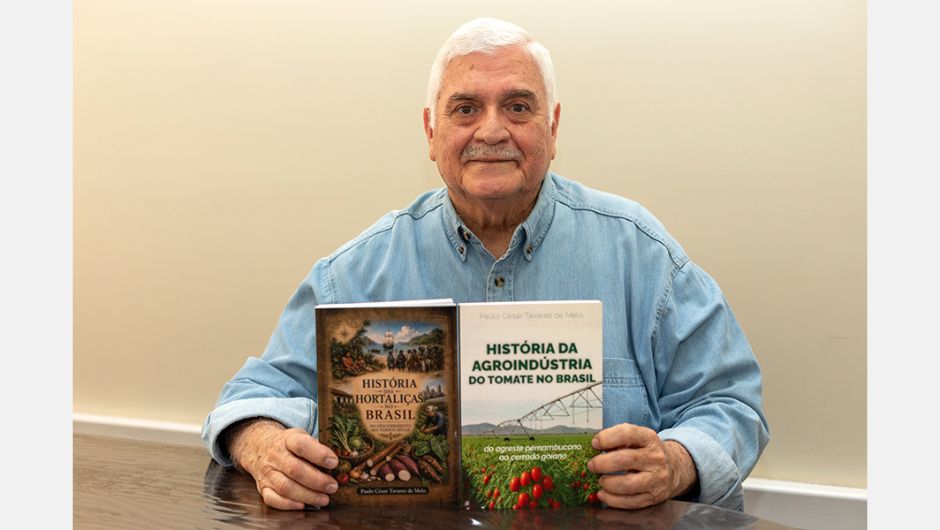
"The History of the Tomato Agroindustry in Brazil: from the Pernambuco hinterland to the Goiás savanna" is the subject of a new work by Paulo César Tavares de Melo, a retired professor from the Department of Plant Production at the Luiz de Queiroz Higher School of Agriculture (Esalq/USP). The work traces a timeline beginning in 1890 and extending to the present day, addressing the challenges and innovations of this segment of the Brazilian agroindustry.
The book emerged after Tavares de Melo retired and took on the challenge of reconciling historical facts with the scientific advances that contributed to the development of the tomato agro-industrial chain in Brazil. According to the author, the crop is of significant importance to national agriculture, mainly due to its production destined for industrial processing and its capacity to generate jobs.
“Throughout this 135-year history of culture in Brazil, I have had the opportunity to witness, over the last 50 years, the main challenges and innovations that have transformed this dynamic segment of the Brazilian food agro-industry. Therefore, in addition to the stories of other key figures that I sought to tell, my own stories, experiences, and memories were also narrated,” he states.
The book is organized into six chapters. In the first, dedicated to "Industrial Processing in Brazil - A history dating back to the end of the 19th century," Tavares de Melo addresses the emergence of the sector, highlighting the Companhia Manufactora de Conservas Alimentícias, founded in 1890 in Rio de Janeiro, and the Fábrica Actividade, located in Olinda (PE), which began operations in 1893, producing tropical fruit wines and tomato paste.
In the second chapter, the author addresses the "Rise and fall of the agro-industrial hub of tropical fruits and tomatoes in Pesqueira," discussing the trajectory of tomatoes in the municipality of Pesqueira (PE), with emphasis on its historical relationship with Indústrias Alimentícias Carlos de Britto SA (Fábricas Peixe). He constructs a detailed narrative about the company, founded in 1898 as a family business that initially processed guava, araçá, cashew, and fig for the production of sweets and later incorporated the manufacture of tomato paste.
The third chapter – “The tomato agro-processing hub of the Lower-Middle São Francisco: from euphoria to ruin” – recounts that, in the mid-1970s, tomato processing activity in Pesqueira was already showing signs of sharp decline. At that same time, however, prospects for the emergence of a new tomato agro-industrial hub were focused on the Lower-Middle São Francisco Valley, along the Petrolina (PE) – Juazeiro (BA) axis.
The topic "The Italian immigrants initiated tomato processing in the state of São Paulo" is addressed in the fourth chapter. The work discusses the establishment of the tomato agro-industry in the state, mainly by the Italian community, making the activity thriving and generating many jobs. The author describes the history of tomatoes in São Paulo in three phases: the first, between 1930 and 1960; the second, in the following 20 years; and the third, from the beginning of the 1990s to the present day.
In the fifth chapter, “Cerrado Goiano, the largest agro-industrial tomato hub in Latin America,” the history of the important tomato agro-processing center established in the Cerrado Goiano region from the mid-1980s onwards dates back to the early 1970s. From that time, research efforts were undertaken to generate information and knowledge about the cultivation of ground tomatoes for industrial processing under the agroclimatic conditions of the Cerrado Goiano. The chapter presents a synthesis of the most relevant research and experimentation work carried out between 1972 and 1980.
“50 years of research and development in genetic improvement of industrial tomatoes in Brazil” is the theme of the book's final chapter, which provides a synthesis of the research conducted on industrial tomato cultivation over the last 50 years. The work concludes with detailed evaluations of the contributions of researchers from various research institutions in Brazil.
The book “History of the Tomato Agroindustry in Brazil: from the Pernambuco hinterland to the Goiás savanna” was edited by Paulo César Tavares de Melo with support from the Brazilian Horticulture Association (ABH), Blueseeds, Vivati Viveiro do Tietê and AGL Seeds. Those interested in purchasing it should contact the author via WhatsApp at +55 19 99715-4503.
Tavares de Melo is expected to release a new book soon. It will be titled "History of Vegetables in Brazil: from development to the present day".
Receive the latest agriculture news by email



Receive the latest agriculture news by email