Inmet: weather forecast between February 16th and March 23nd.
A frontal system is expected to cause instability in the South between Tuesday and Thursday.
16.03.2026 | 16:13 (UTC -3)
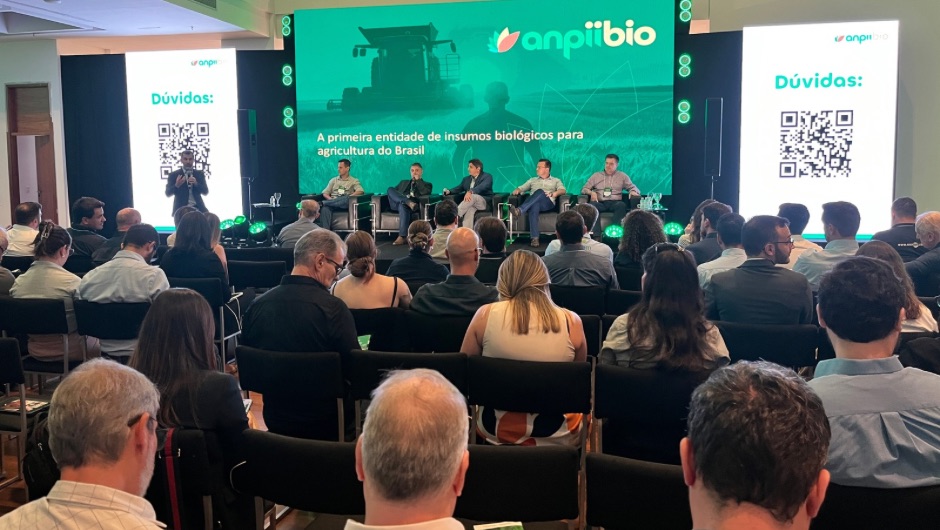
“We are in the midst of a bio-inputs revolution.” This statement was made by the president of the National Association for the Promotion and Innovation of the Biological Industry (Anpii Bio), Thiago Delgado, at the opening of the 3rd Market Intelligence Workshop, held this Tuesday (March 17th) in Campinas. With more than 200 registered participants, the event opened the participation of non-members for the first time.
According to Delgado, the bio-inputs market is experiencing a moment of consolidation, advancing into spaces traditionally occupied by chemical products. "There is a movement of acquisitions, the entry of new technologies, and segments where biological products are already the producer's preferred choice, such as nematicides," he highlighted.
The executive also highlighted the changing regulatory landscape. According to him, the sector is discussing its own legislation, more aligned with the specificities of bio-inputs. "We are moving away from the logic of the agrochemical law to build an appropriate regulation that includes products with multiple functions, expands quality control, and provides greater legal certainty," he stated.
Among the challenges, Delgado cited diagnostic failures in sales, lack of knowledge on the part of producers, communication difficulties, obstacles in biofactories, and competition between public and private research. "The future lies in specialization," he summarized.
In the international arena, Ignacio Moyano Córdoba, Vice President of Business Development for Latin America at Dunham Trimmer, presented market data and projected growth of up to 9,7% in biologicals between 2025 and 2030. Currently, the segment is led by biocontrol, which represents 55% of the market, followed by biostimulants (28%) and biofertilizers (17%). When segmented by crop, grains and cereals lead in usage with 31%. North America and Europe remain the most mature regions.
According to Córdoba, the main barrier to the adoption of bio-inputs is still the lack of information. In a survey conducted by the Food and Agriculture Organization of the United Nations (FAO) with 3,4 producers, 57% pointed to this factor as a limiting one. "Adoption depends on information, training, and consistent results," he stated. For the industry, this implies expanding local validations, technical support, and agronomic interaction.
Cleber Vieira, managing partner of Agroconsult, addressed the challenges faced by Brazilian producers and the outlook for the 2026/27 harvest. According to him, international conflicts continue to impact strategic supply chains, such as sugarcane, coffee, soybeans, cotton, and fertilizers.
“This is a complicated year. We don’t have all the answers yet, but there are guidelines to get through 2026 without increasing losses and to allow for a recovery in 2027,” he assessed.
Anpii Bio's operations director, Larissa Bonotto, highlighted that the use of bio-inputs requires a change in management practices and a higher level of technical expertise in the field. “Biologicals are not for those who want to do the bare minimum. It demands knowledge, care in handling, transportation, mixing, and application. Given the current scenario, producers who want to make it profitable will have to evolve,” she stated.
According to her, the context of pressure on margins could boost adoption. "It's a challenging time, but also an opportunity to advance and consolidate the sector's development," she added.
The program concluded with a roundtable discussion on the bio-inputs market, its relationship with agricultural commodities, and the outlook for the coming years.
Receive the latest agriculture news by email


Receive the latest agriculture news by email