Bill on renegotiating rural debts advances in the Senate.
Bill creating special financing with resources from the Pre-Salt Social Fund goes to a vote in the Plenary.
27.05.2026 | 17:03 (UTC -3)
The Senate Agency
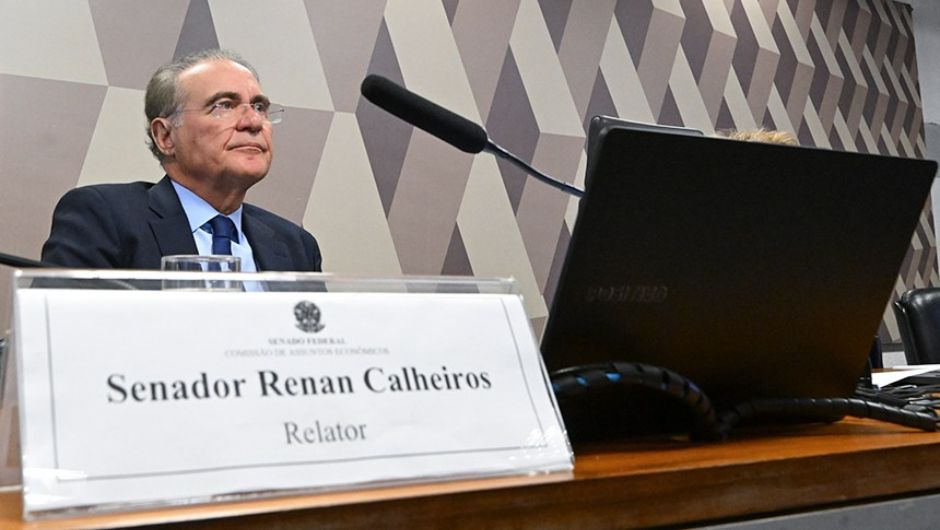
The bill authorizing the use of resources from the Pre-Salt Social Fund and other authorized sources to create a special financing line for rural producers (PL 5.122/2023) was approved this Wednesday (May 27) by the Committee on Economic Affairs (CAE). The text was the result of extensive negotiation between the government and Congress and much debate in the committee. Now, the bill goes to a vote under urgency in the Senate Plenary.
Originally proposed by Congressman Domingos Neto, the text provided for financing for producers affected by climate events — such as El Niño, for example. However, in his report, the president of the CAE (Committee on Economic Affairs), Senator Renan Calheiros, broadened the scope of the bill to include producers affected by negative economic impacts resulting from international geopolitical conflicts.
The Pre-Salt Social Fund (FS), established by Law 12.351 of 2010, receives money from oil exploration, in addition to financing projects and programs in various areas such as education, public health, the environment, and mitigation and adaptation to climate change.
According to the text, the current revenues of the Social Fund for 2026 and 2027, the financial surplus recorded at the end of 2025 and 2026, the financial surplus of other funds supervised by the Ministry of Finance, and other sources defined by the Executive Branch may be used to provide a special line of financing for actual producers, that is, those who actually produce in the field.
Financial limits and conditions
The credit can be used to settle debts from rural credit, loans, and Rural Product Certificates contracted until December 31, 2025, whether renegotiated or not. The debts will be recalculated without fines, late payment fees, or other charges for default.
Regarding the terms, interest rates will vary depending on the producer's profile:
3,5% per year for those enrolled in the National Program for Strengthening Family Farming (Pronaf) and other small producers;
5,5% per year for those enrolled in the National Program to Support Medium-Sized Rural Producers (Pronamp) and other medium-sized producers;
7,5% per year for the rest.
The funds may be managed by the National Bank for Economic and Social Development (BNDES), banks, and credit cooperatives. The special line of credit will have a global limit to be defined in the future by the Executive Branch.
The financing will be limited to R$10 million per beneficiary and R$50 million per association, production cooperative, or condominium. The repayment term may reach 10 years, plus a three-year grace period, depending on the case.
Beneficiaries
The beneficiaries are rural producers, associations, production cooperatives, and condominiums that meet objective criteria related to calamity and production losses. These are some of the conditions outlined in the text:
that have recorded, between 2019 and 2025, losses in two or more harvests that resulted in a reduction of at least 30% of the expected gross agricultural income for the respective harvest, as proven by a report issued by a qualified professional;
to have a business located in a municipality whose state or the municipality itself has declared a state of emergency or public calamity, recognized by the federal or state Executive Branch, in at least one year between 2019 and 2025; or to be located in a municipality that has recorded at least two production losses of at least 20% of the average yield in at least two of the three main agricultural activities during the period;
The percentage of total rural credit debts overdue by more than 90 days and renegotiated rural credit debts exceeds 10% of the municipality's total rural credit portfolio as of December 31, 2025.
The beneficiary, during the analyzed period, demonstrates cash flow difficulties due to the accumulated impact of crop losses resulting from adverse weather events in previous harvests, or due to the negative economic impacts resulting from international geopolitical conflicts that caused revenue losses and increased costs, consequently increasing indebtedness within the National Rural Credit System (SNCR) and preventing the full repayment of rural credit operations.
For beneficiaries located in the area of the Superintendency for the Development of the Northeast (Sudene), the analysis period will be from 2012 to 2025.
Other funds
The text also authorizes that, within their available resources and areas of operation, the Constitutional Financing Fund for the North (FNO), the Constitutional Financing Fund for the Northeast (FNE), the Constitutional Financing Fund for the Central-West (FCO), and the Fund for the Defense of the Coffee Economy (Funcafé) be used to implement special financing for producers.
If the resources of these funds are exhausted in their areas of coverage, the Social Fund may assume the implementation of the measures and the corresponding costs.
The bill also authorizes financial institutions to extend the due dates for principal and interest payments on covered transactions by 180 days. During this period, administrative collections, extrajudicial, judicial and tax enforcement actions, registration in negative credit databases, and respective procedural deadlines are suspended.
amendments
The rapporteur said he considered the proposal urgent and appropriate given the increase in extreme weather events and the economic impact on rural producers. In his vote, Renan states that the use of the Social Fund is compatible with the fund's legal purposes, especially in supporting actions to mitigate and adapt to climate change.
He proposed changes to the text through amendments. Among them are the expansion of the scope of debts to operations contracted until December 31, 2025 (the original text stated June 30, 2025); the authorization to use other sources of funds, in addition to the Social Fund; the creation of additional mechanisms for extending and restructuring rural debts; and the extension, for the Sudene area, of the period for analyzing calamities and productive losses to 2012 to 2025.
The report also seeks to prevent sub-legal regulations from restricting the application of the new law, especially through simultaneous requirements for declaring a state of emergency at both the state and municipal levels.
A total of 54 amendments were presented. In his opinion, Renan proposed the partial acceptance of amendments 2, 20, 49, 51, and 53. Based on amendment 2, from Senator Tereza Cristina, Renan added authorization for the Union to expand its participation in the Investment Guarantee Fund (FGI), exclusively for covering credit operations intended for the renegotiation of rural debts.
Amendment 51, also by Tereza Cristina, seeks to increase the transparency of data regarding these renegotiations. Amendments 20, 49, and 53 were partially adopted for adjustments to eligibility, interest rates, and correction of fiscal impacts. The remaining amendments were rejected.