Court bans use of herbicide 2,4-D in Campanha Gaúcha
Decision vetoes application of the product throughout the region
03.09.2025 | 20:05 (UTC -3)
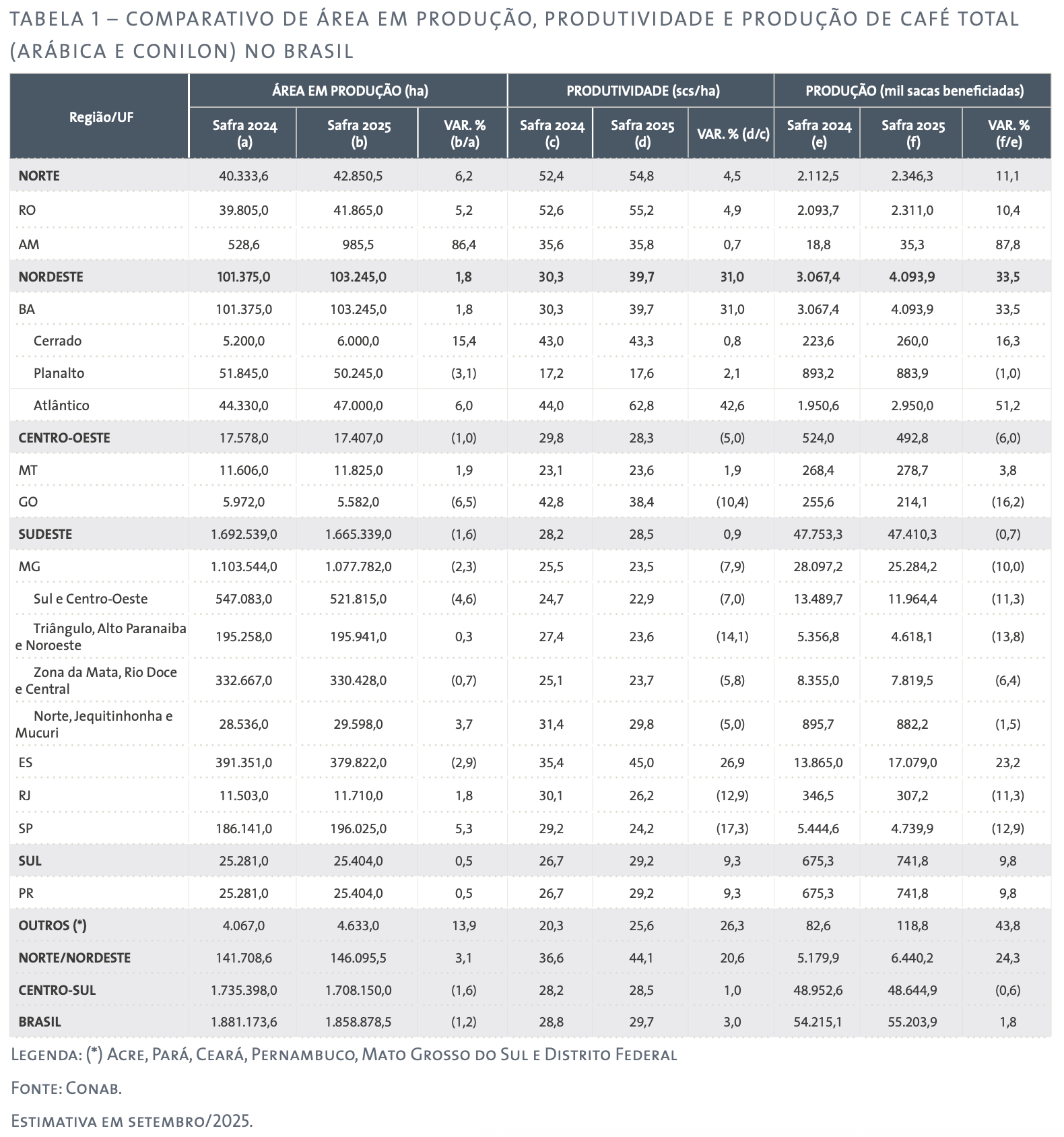
With 96% of the area harvested by the end of August, the 2025 Brazilian coffee harvest is expected to reach 55,2 million processed bags. This represents a 1,8% increase compared to the 2024 volume. The data was released by the National Supply Company (Conab).
Production grew despite the negative biennial cycle, a natural effect that reduces crop yields in alternate years. The main factor behind the increase was a 3% increase in average national productivity, which rose from 28,8 to 29,7 bags per hectare. In 2024, despite being a positive biennial cycle year, the weather affected crops in several producing regions.
The area under production fell 1,2% and is estimated at 1,86 million hectares. In contrast, the area under development increased 11,9%, totaling 395,8 hectares. The total area under coffee cultivation in 2025, including both production and development crops, will reach 2,25 million hectares, a 0,9% increase over the previous year.
Arabica coffee is expected to account for 35,2 million bags, a decrease of 11,2% compared to the previous harvest. This decline is due to the low biennial cycle and the reduction in the area under production. Minas Gerais remains the leading producer, with 1,38 million hectares, representing 75,2% of the national Arabica area. In the state, production is expected to reach 24,7 million bags, a decrease of 10,8%. The prolonged drought before flowering exacerbated the decline.
Conilon, on the other hand, shows a contrasting performance. The estimated 20,1 million bags of processed coffee are produced, a 37,2% increase year-over-year. The good weather regularity during the critical crop seasons favored flowering and fruit formation, especially in Espírito Santo. The state accounts for 69% of national conilon production and is expected to harvest 13,8 million bags, 40,3% more than in 2024.
In Bahia, total coffee production (Arabica and Conilon) is projected at 4,1 million bags, a 33,5% increase. This growth is driven by new, high-yield irrigated crops, mainly along the coast and in the Bahian Cerrado. Conilon, which accounts for 72% of state production, grew 51,2%, reaching 2,95 million bags. Arabica, meanwhile, rose 2,4%, reaching 1,1 million bags.
Rondônia is also expected to increase production. The estimate is 2,3 million bags in 2025, a 10,4% increase over the previous cycle.
Receive the latest agriculture news by email


Receive the latest agriculture news by email