





Potential of the Semiarid region for Brazilian agriculture
By Maria Auxiliadora Coêlho, General Manager of Embrapa Semiarid
12.06.2023 | 14:41 (UTC -3)
Evaluation of fertilizer dosing mechanisms shows the behavior of each model operating at different speeds.
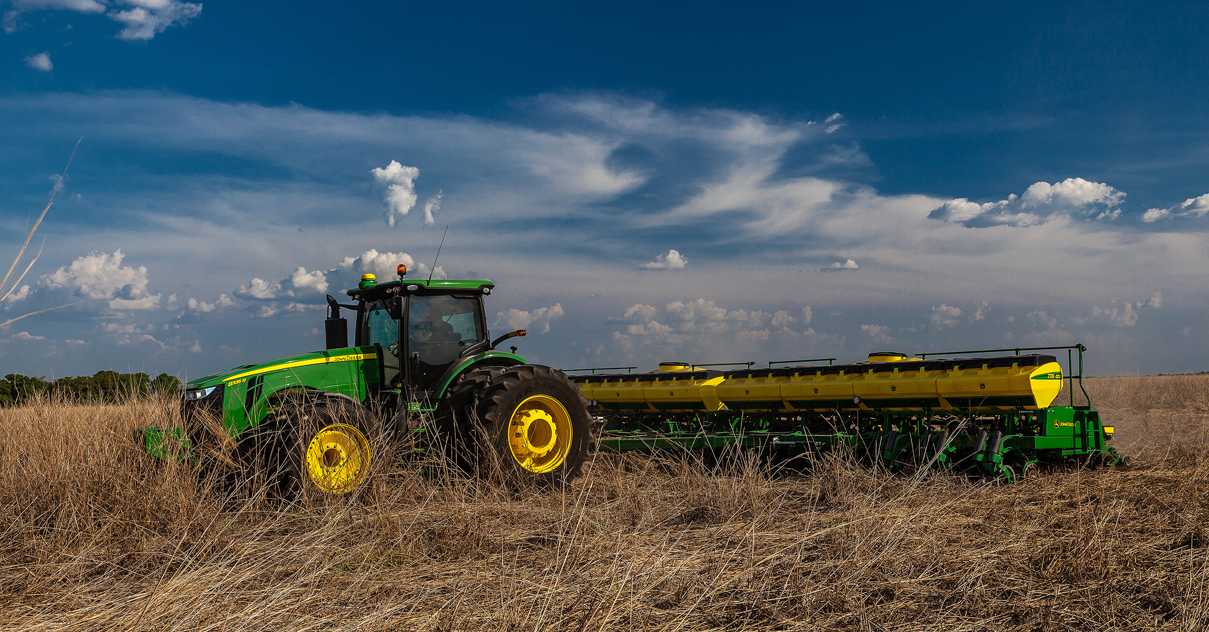
The seeders available on the market have dosing mechanisms of different types, the most common being those of the helical type, which is composed of a helicoid, which can be inserted into different types of housing. The rotation of this threaded shaft causes the product to be conveyed from the reservoir to the ground, through the dosing mechanism and conductive tubes. These mechanisms are capable of distributing a fixed or variable rate of fertilizers uniformly, regardless of working conditions. Adjustment of the dosage rate of dosing mechanisms occurs through the pitch of the helicoids and the rotation of the shafts, which can be changed by using different gears. However, there are few studies related to the evaluation of dosing mechanisms in seed-fertilizers under field conditions.
Due to the lack of knowledge about the performance of helical metering mechanisms present in seeders-fertilizers, researchers from the Federal University of Mato Grosso carried out work with the objective of evaluating the performance of helical metering mechanisms by gravity and with overflow, making a performance list when application rate and speed conditions changed. The studies related to dosing mechanisms were carried out on a rural property located in the municipality of Feliz Natal (MT).
The equipment for the tests consisted of a Sol Tower Plantio Direto model seeder from the Semeato brand, which in the test is represented by the acronym S1. It has 11 pantographic sowing lines and a spacing of 0,5 m between lines, a simple and smooth disc straw cutting mechanism and furrow opening using a mismatched double disc furrowing mechanism. It has a gravity helical fertilizer dosing mechanism, containing one-inch pitch helicoids, a fertilizer reservoir with a capacity of up to 2.000kg. The seeder was driven by a John Deere 6110J tractor, 4x2 TDA and 110hp maximum power. The test was carried out with half a load of fertilizers, evenly distributed within the reservoir.
The other equipment used was the John Deere seeder, model of the 2100 series, which will be represented by the acronym S2, it was formed by a tandem, totaling 20 pantographic type sowing lines with a spacing of 0,5m, used in the test just a seeder with ten rows. With simple and smooth disc straw cutting mechanism and offset disc type furrowing mechanisms. This seeder has a dosing mechanism known by the manufacturer as ProMeter, which consists of a helical dosing mechanism with lateral overflow, with all units (lines) having a one-inch pitch helicoid. The reservoir of this seeder has a capacity of approximately 2.800kg. For this seeder, the John Deere 7225 tractor with 225 hp was used. The lowest fertilizer application rate required initially was 250kg/ha and the highest rate was 400kg/ha. However, the S1 seeder had a setting closer to 256kg/ha and the S2 seeder had a setting closer to 242kg/ha. For maximum application, the S1 seeder had a setting closer to 427kg/ha and the S2 seeder, 376kg/ha.
The treatments were named as follows: two dosing mechanisms represented by seeders S1 and S2; two fertilizer application rates called T1 and T2 (250kg/ha and 400kg/ha) and four speed values that are V1, V2, V3 and V4 (5,2km/h, 6,5km/h, 8,2km/h h and 9,5km/h). Each treatment was carried out in plots 20 m long and with a width determined by the implement. Before preparing for sample collection, the tractor operator activated the seeder so that it applied fertilizer to the soil, aiming to stabilize the fertilizer flow in all sowing units.
For the tests, the samples were collected in plastic bags fixed to the conductive tube of the dosing mechanisms identified with the respective sowing line of the machine and the dosing mechanism. The compared variables were subjected to means testing. The fertilizer used had a density of 1,09g cm-3, water content of 1,30% and angle of repose of 30,4°.
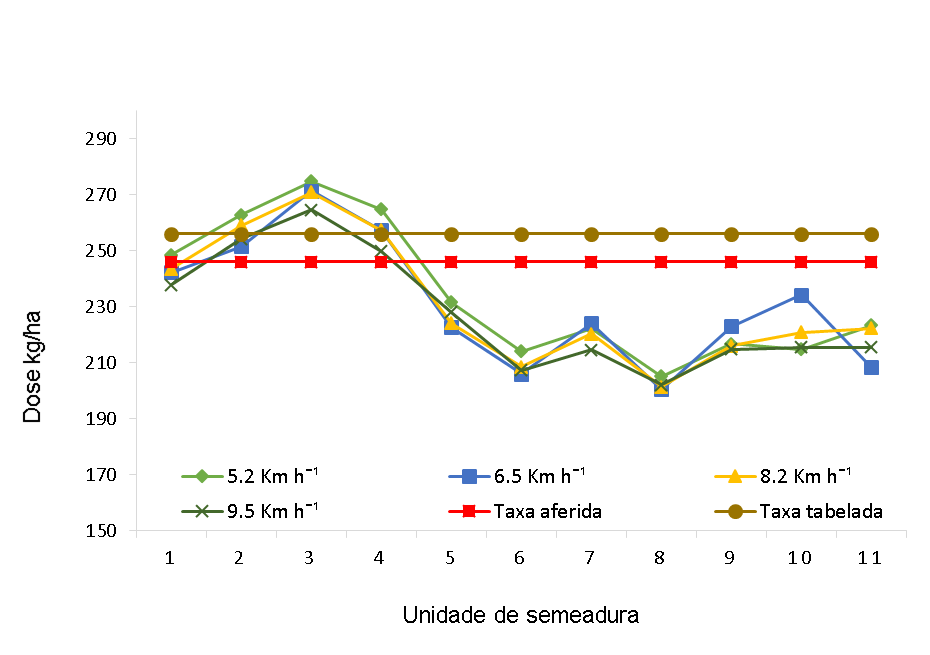
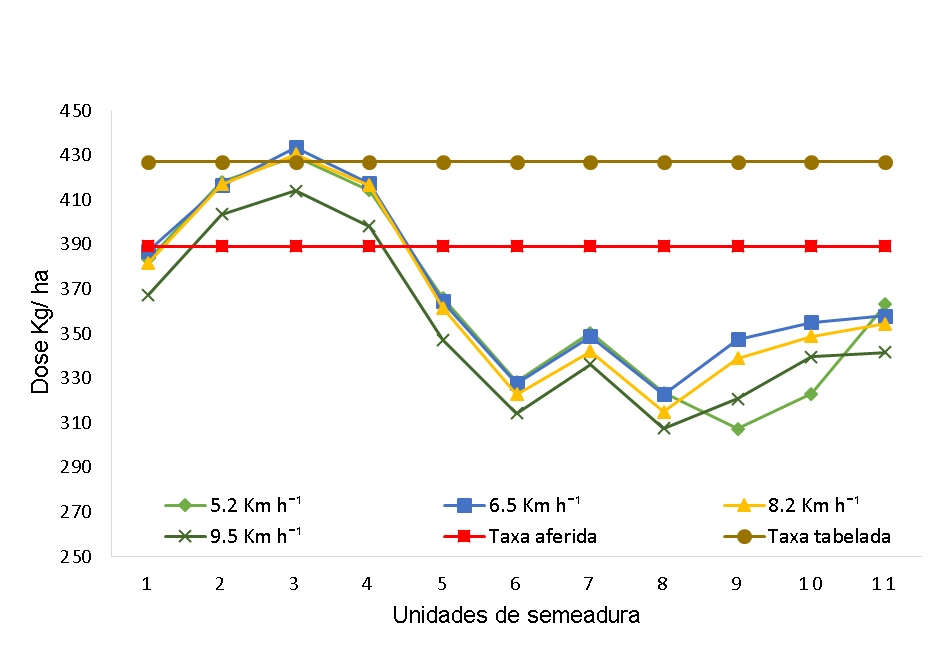
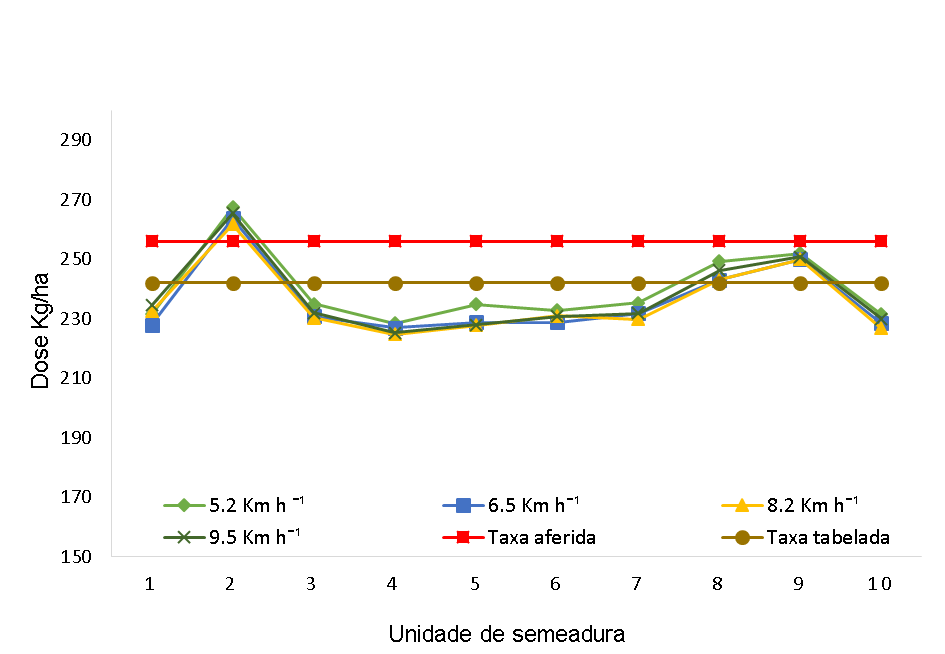
Evaluating the sowing lines, it is notable that seeding units 2 to 4 presented higher dosage at all tested speeds. Seeding units 5 to 11 showed underdosing at all speeds (Figure 1), showing a tendency for transversal dosing on different sides of the seeder. There was a greater disparity between the tabulated and measured T2 dose rate, when compared to the T1 rate (Figure 2).
The S2 seeder at the T1 dose rate is represented by Figure 3, where it is possible to notice the great disparity between the tabulated dose and the measured dose at the T1 rate. The non-uniformity in the application profile of the S2 seeder is notable, the sowing unit 2 exceeded the dosages at all speeds, with behavior similar to units 8 and 9, which presented overdose values, but in a smaller proportion when compared to the sowing unit 2. The behavior of the seeding units was the same at all four speeds.
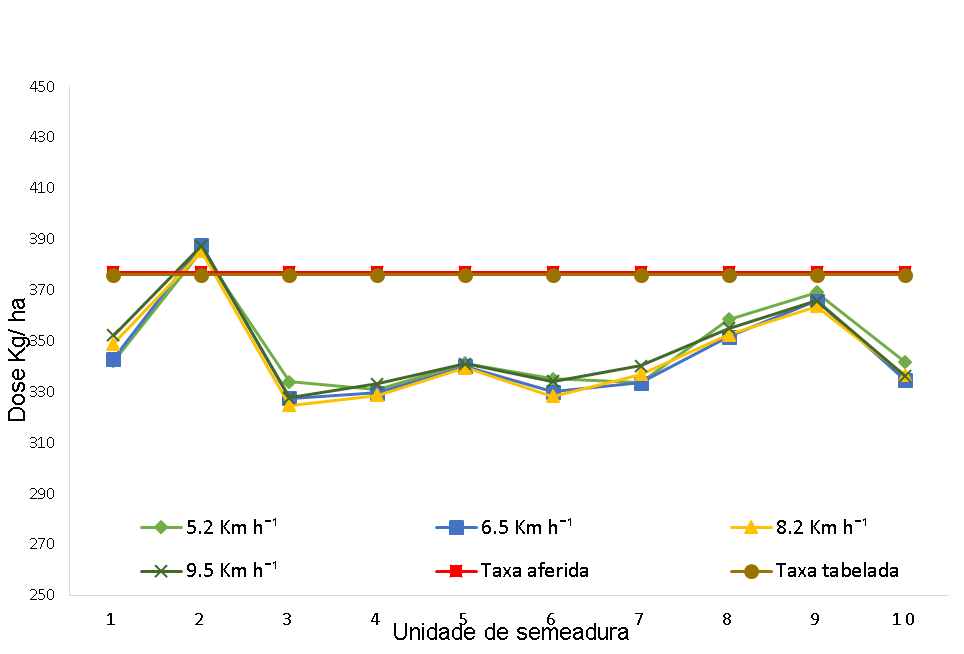
It is noted that the tabulated dosage rate was exactly the same as the measured one. The behavior of the sowing units followed a profile at both dosage rates tested, with little variation between the speeds to which the seeder was subjected. as exemplified in Figure 4.
When comparing the dosing mechanisms, the helical gravity dosing mechanism had significantly lower performance when compared to the helical overflow dosing mechanism (Table 1).
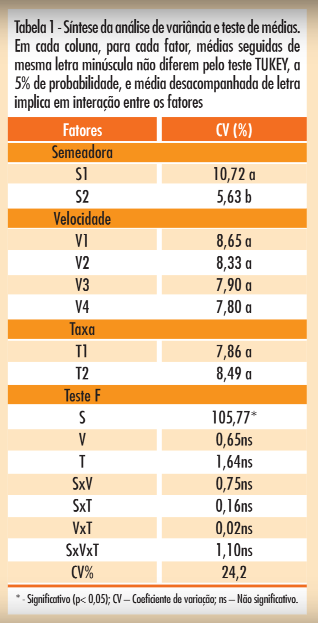
The helical overflow metering mechanism in the test demonstrated by the S2 seeder proved to be more precise than the gravity metering mechanism of the S1 seeder. The dosing mechanisms evaluated showed distribution regularity within the recommended range.
The increase in travel speed did not cause a significant change in the performance of the dosing mechanisms, only in the seeder (S1) with a gravity dosing mechanism at the highest speed, the average dosage obtained in this treatment differed from the others. The application rate did not show a significant difference during the evaluation of the seeders.
Thiago Martins Machado, Gustavo Reinhr Faganello, Gabriel Benhossi, Wagner Zy Ferrari and Estevão Querino de Souza, UFMT - Sinop Campus (MT)
Article published in issue 185 of Cultivar Máquinas, June 2018.
Receive the latest agriculture news by email



Receive the latest agriculture news by email