Soybean sowing quality
The sowing process is subject to the interference of several factors, from the correct choice of seed to the mechanisms responsible for its dosage and deposition.
19.06.2023 | 16:29 (UTC -3)
Despite technological advances in mechanized sugarcane harvesting, the qualification and training of operators are still points that need to be advanced to guarantee better results in the operation.
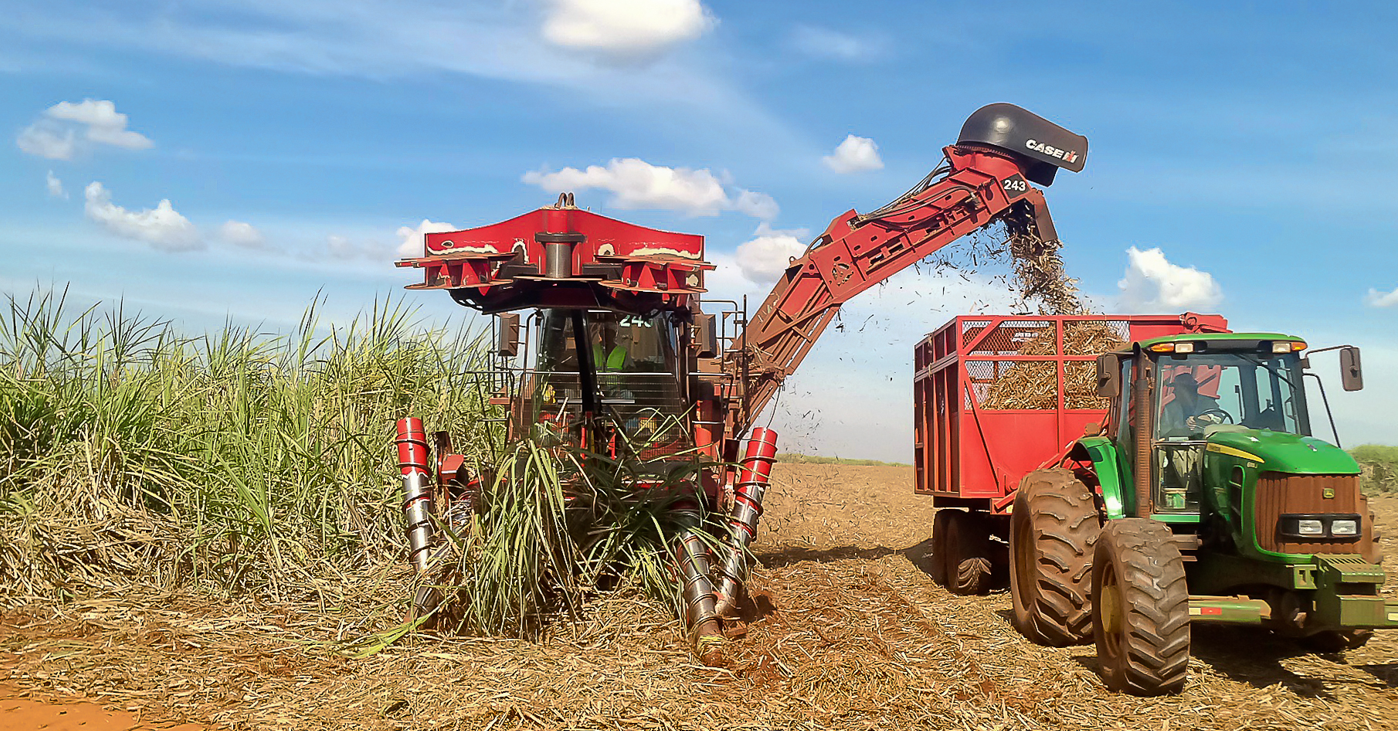
Brazil cultivates a third of all sugar cane on the planet, corresponding to around nine million hectares, with more than half of this total cultivated in the state of São Paulo alone. After the creation of the Environmental Protocol in 2007, an agreement signed between the state of São Paulo, the industry and sugarcane suppliers to bring forward the end of straw burning, the sugar-energy sector underwent major transformations, mainly regarding the use of machines in harvesting. .
According to information from the Sugarcane Technology Center (CTC) and the National Bioethanol Science and Technology Laboratory (CTBE), in the Center-South, the main sugarcane producing region, mechanized harvesting increased from 48% in 2008 to a value close to 100% nowadays, while the average value considering all of Brazil would be 75%.
With the establishment of the Protocol and the reduction in available labor, mechanized harvesting in Brazil became an irreversible process, but caused major impacts on the longevity, losses and productivity of sugarcane fields, causing sugarcane fields that produced 80t/ha between 2004 and 2006 started to produce 70t/ha currently.
Given the size of sugarcane in Brazil and the scenario established in recent years, we have seen the search for high operational yield, with harvests carried out 24 hours a day and the emergence of new models of harvesters, called multi-lines, capable of harvest two or more lines simultaneously.
However, there is little work carried out with the aim of evaluating the quality of the operation carried out by these machines and during day and night shifts, which directly affect the operator's visibility. Therefore, a group of researchers from Unesp and Ifro carried out an assessment of the operational quality of mechanized sugarcane harvesting carried out by a multi-row harvester during day and night harvest shifts.
The study was carried out in an agricultural area with an altitude of 610m and a slope of 3,5%. The predominant soil in the studied area was classified as Dystrophic Red Oxisol (Santos et al, 2013), the climate Cwa according to the Köppen classification (Alvares et al, 2013) and the cultivated variety was CTC 20.
The harvester evaluated was a Case model A8800 multi-row, with nominal power of 263kW (358hp) at 2.100rpm, equipped with track wheels (45mm wide) and 2,4m gauge, operated at an average travel speed of 2,5 2km/h during the day and 1.800km/h at night, average engine speed of XNUMXrpm and, at the time of harvest, the automatic steering system was turned off.
The harvester's front base cutting system, with an independent height control system, consisting of two 1m diameter discs, equipped with 12 cutting knives each and a 45° inclination, worked at an average pressure of 85bar. The collection system (central), consisting of two discs equipped with five collection elements (cutting knives) and an automatic Autofloating cutting height control system, worked at an average pressure of 55bar.
This harvester model was capable of harvesting two or more rows of sugarcane simultaneously, due to its adjustable platform (“open and close” system) capable of adapting the front opening to the spacing of the sugarcane field.
To evaluate the harvest, the premises of statistical process control were followed, with 42 points per shift being evaluated approximately every five minutes, totaling 84 points.
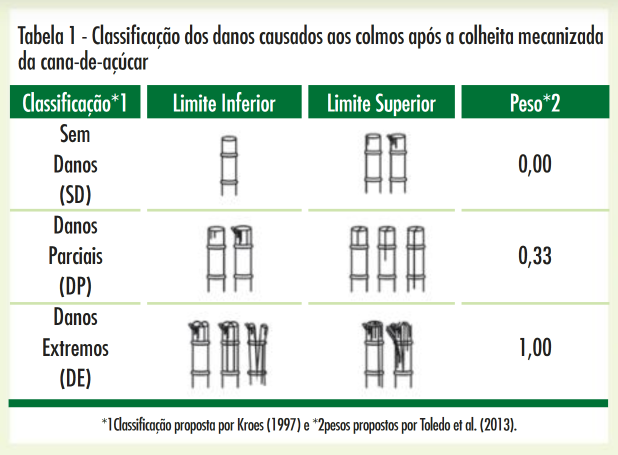
As quality indicators, the stump damage indices proposed by Toledo et al (2013) were used, corresponding to the calculated values based on the stump sampled and evaluated in a 0,25m2 frame.
Damage to ratoons is visually classified based on the limits established by Australian Sander Kroes (Table 1), and the calculation of the damage index is carried out based on the values assigned to each damage range.
During the evaluation, different situations were found, with extreme damage, with the ratoon heavily damaged after mechanized harvesting and also an ideal situation, with the cut carried out perfectly, causing no damage to the ratoon, which will favor the longevity of the sugarcane field.
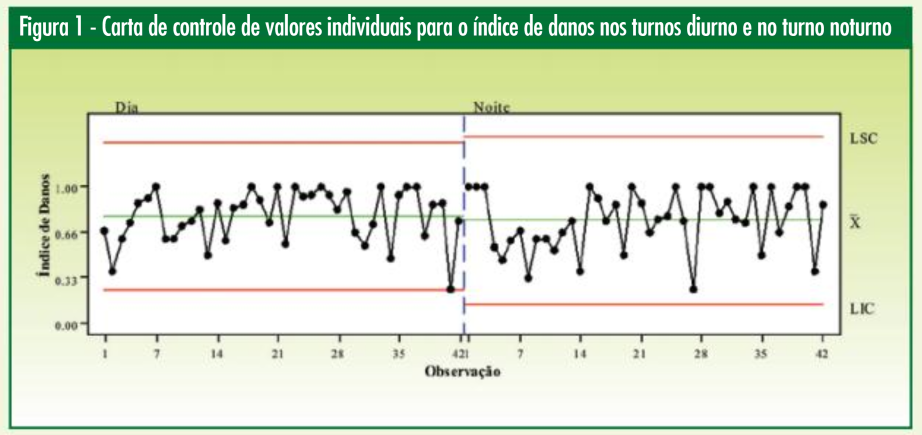
As a tool to analyze the data, the control chart of individual values of statistical process control was used, in which the central line (green) represents the general average of the process and the red lines represent the upper (LSC) and lower limits (LSC). LIC) control or process variability. This feature is widely used to monitor the operational quality of machines in industry and adapted to agricultural conditions.
When observing the effects of shifts on the damage rate, it was found that the variability was higher in the night shift, that is, lower operational quality, while the extreme damage values were close and high for both shifts, with 74% in the day shift versus 71% in the night shift (Figure 1).
Visibility is an extremely important factor in mechanized sugarcane harvesting (Noronha et al, 2011), and as it involves simultaneous harvesting of two lines, it becomes even more important, as no targeting technology was used. automatic, which favors the loss of orientation at the time of harvest, causing greater damage to the ratoons and loss of material rich in sucrose.
In addition to the wear observed on the knives of the base cutting mechanism, another important factor was that during the night harvest the relative humidity of the air was high, causing the harvested material to have greater humidity and impairing the quality of the cut, often observed by the harvester overload, requiring continuous harvester breaks.
Therefore, it appears that technologies, such as the multi-row harvester, are necessary to meet the new demands that have arisen with the transformation of the sector. However, operational quality still comes up against factors already known, but still neglected, which range from the lack of maintenance of cutting knives, the failure to use the autopilot for guidance in low visibility conditions, to the failure to consider environmental conditions and sugarcane fields at the time of harvest.
Lucas Augusto da Silva Gírio, FCAV - Unesp Jaboticabal; Patricia Candia de Menezes, Ifro, Western Colorado; Franciele Morlin Carneiro, Tiago de Oliveira Tavares, Rouverson Pereira da Silva, FCAV - Unesp Jaboticabal
Article published in issue 186 of Cultivar Máquinas, July 2018.
Receive the latest agriculture news by email


Receive the latest agriculture news by email