Discipline in the air: new legislation for the use of drones in Brazil
By Jorge Wilson Cortez and João Gabriel Ruppenthal, from UFGD
01.10.2026 | 15:13 (UTC -3)
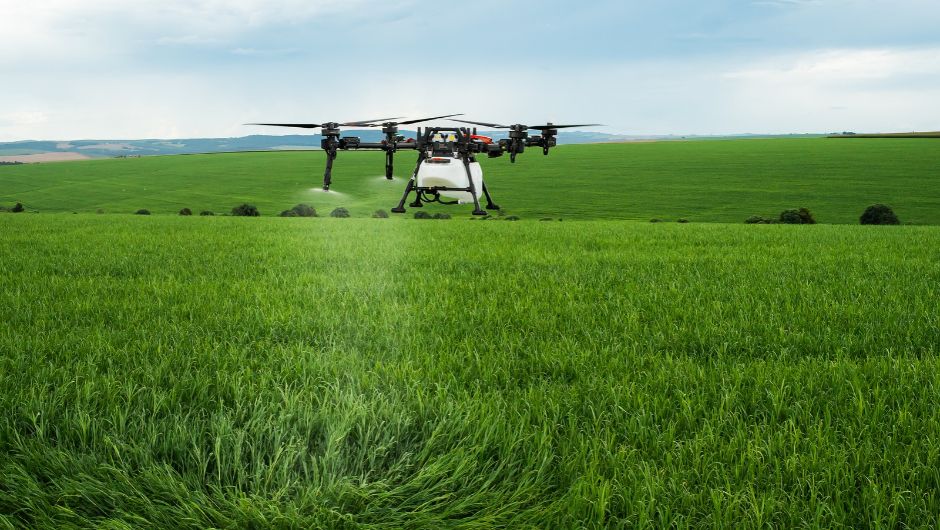
Photo: Case IH
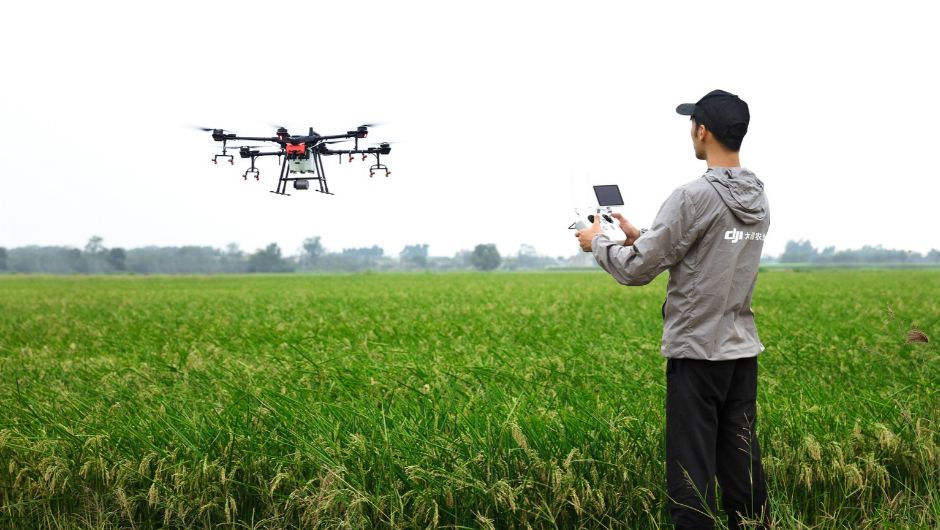
The use of drones has ceased to be an experimental application and has become integrated into the operational routine of various sectors in Brazil. In agriculture, unmanned aerial vehicles are used for mapping, crop monitoring, total area spraying, localized spraying, variable rate application of inputs, seeding, failure inspection, estimation of vegetative vigor, and support for precision agriculture. Outside the rural environment, their use has also become consolidated.
Operating a drone in Brazil is not just a matter of turning on the equipment and taking off. The operation involves responsibilities to the National Civil Aviation Agency (ANAC), the National Telecommunications Agency (ANATEL), the Department of Airspace Control (DECEA), and, when it comes to agricultural applications, also to the Ministry of Agriculture and Livestock (MAPA), with a pilot certified by the Remote Aerial Application Course (CAAR).
The term "drone," in popular usage, can be used as a general expression and is easily understood by the public. However, in normative and technical language, especially when dealing with professional, agricultural, commercial, or institutional operations, the correct term is RPA - Remotely Piloted Aircraft (RPA, acronym for "Remotely Piloted Aircraft").
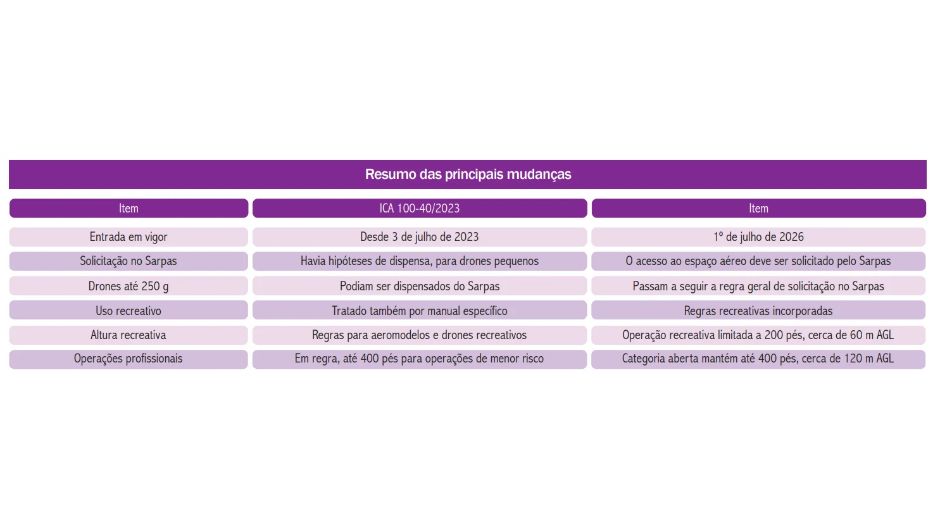
Since July 1, 2026, the new ICA 100-40 has reorganized a significant part of this regulatory environment, with a direct impact, primarily, on recreational operators and service providers, among others. The standard uses the technical term Unmanned Aircraft (UA).
What is ICA 100-40?
ICA 100-40 is the Brazilian Air Force Command Instruction that establishes the procedures and responsibilities for safe access to Brazilian airspace by unmanned aircraft. In practical terms, it defines how, when, and under what conditions an RPA (drone) can access airspace under Brazilian jurisdiction.
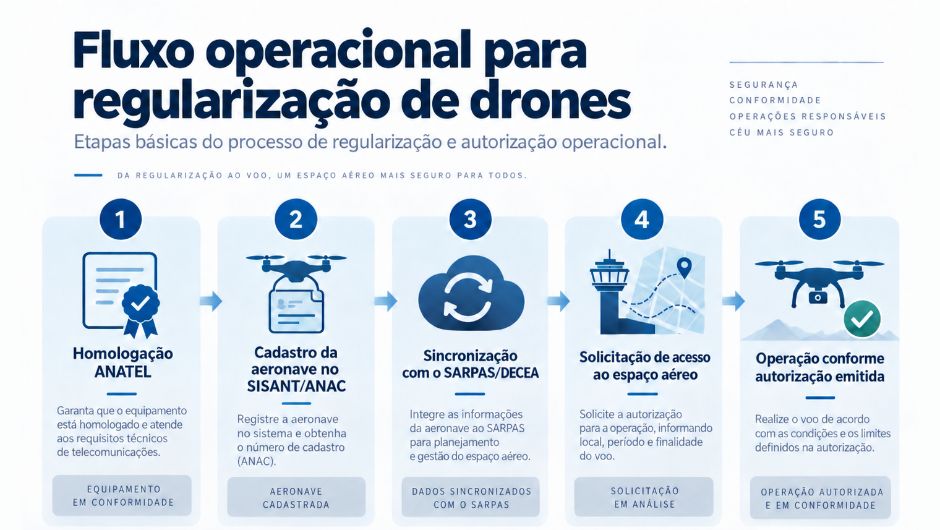
While ANAC deals with airworthiness requirements, registration (Unmanned Aircraft System - Sisant), aircraft classification and aspects of civil aviation, and ANATEL deals with the homologation of radio communication equipment, DECEA regulates access to airspace through SARPAS - System for Requesting Access to Brazilian Airspace by Unmanned Aircraft.
What changes from July 1, 2026
As of July 1st of this year, the new ICA 100-40, approved by Decea Ordinance No. 2.094/DNOR8 of March 18, 2026, has come into effect. The new edition revokes ICA 100-40/2023 and also consolidates content previously covered in specific manuals, including rules for recreational use and special air operations.
The central point is the mandatory prior request for access to airspace through Sarpas for all unmanned aircraft, regardless of weight. With this, drones weighing up to 250g, which previously had preferential treatment under certain conditions, now require Sarpas authorization for airspace access, except for specific exceptions provided for in the regulation itself, such as recreational operations carried out in airspace designated for recreational purposes.
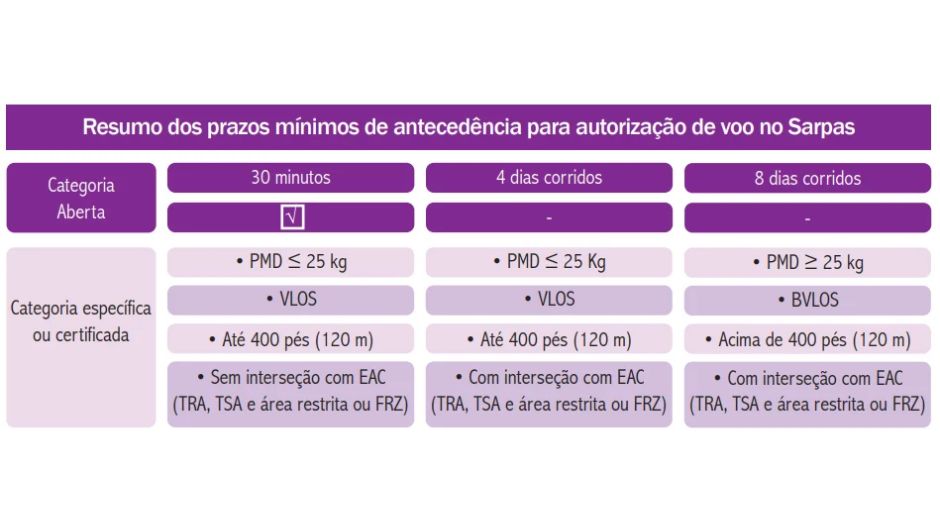
The new rule maintains the minimum 30-minute advance notice for less complex operations, for requests in Sarpas, such as the open category and some specific low-risk operations.
The new standard also introduces a clearer logic to the operational categories, as we will explain below.
Open category - Low-risk operation, carried out with an unmanned aircraft weighing up to 25 kg, in VLOS ("Visual Line Of Sight"), up to 120 m in height and without intersection with EAC (Conditioned Airspace) or FRZ (Flight Restriction Zone).
Specific category - Operations that do not fall under the rules of the open category, such as those with a maximum takeoff weight (MTOW) greater than 25 kg, BVLOS ("Beyond Visual Line Of Sight"), above 120 m, or intersecting with EAC or FRZ.
Certified category - Operation performed with a certified unmanned aircraft.
ICA 100-40/2026 also incorporates the concept of UTM Zone (“Unmanned Aircraft System Traffic Management”), that is, Traffic Management of Unmanned Aircraft Systems, understood as a volume of airspace in which there is safe and efficient access for UAS (“Unmanned Aircraft System”) or Unmanned Aircraft System.
The new rule maintains the minimum advance notice of 30 minutes for less complex operations, such as open-ended transactions. For operations requiring more analysis, it stipulates four consecutive days. For specific or certified operations of greater complexity, the minimum timeframe becomes up to eight consecutive days.
In practice, the new ICA increases the operator's accountability and reinforces the need for prior planning.
For recreational use, the flight must observe a maximum altitude of 200 feet, equivalent to approximately 60 m AGL (“Above Ground Level”), and a maximum horizontal distance of 300 m. Thus, although the open category allows for lower-risk professional operations with an altitude of up to 400 feet or 120 m AGL, this limit should not be automatically applied to recreational use. For drones used exclusively for leisure or hobby purposes, the specific limit of 60 m AGL prevails.
The express exception applies only to recreational operations carried out in Conditioned Airspace (CAS) designated for recreation. CAS designated for recreation should be understood as an area of airspace previously defined and formally designated for recreational use of model aircraft or drones. This condition should not be confused with any open area, square, park, farm, or private property where the operator wishes to fly for leisure.
In ICA 100-40/2026, the exemption from requesting access to Sarpas for recreational use only applies when the operation is carried out in an EAC specifically designated for recreation (Article 55, Paragraph 2). Outside of this formalized environment, recreational flight must follow the general rule of requesting access to airspace through Sarpas.
Although ANAC regulations have historically waived mandatory registration in Sisant for drones with a maximum takeoff weight of up to 250 g, DECEA's new operational logic requires additional attention. Since access to airspace must be requested through SARPAS and civil aircraft are made available in this system through synchronization with Sisant, prior registration of the aircraft in Sisant becomes, in practice, a necessary condition for the operator to be able to request flight access through SARPAS, including in the case of light aircraft.
Roadmap for regularization
To operate a drone (RPA), it is necessary to meet the requirements of the equipment, the operator, the purpose of the operation, and the airspace.
After registering the aircraft with ANAC (Brazilian Civil Aviation Agency) through SISNANT (Brazilian Airspace Information System), the operator must issue the corresponding registration certificate. This document must accompany the operation, in physical or digital format, and may be requested by the competent authorities. It is also recommended to keep available the airspace access authorization issued by DECEA (Department of Airspace Control), through SARPAS (Brazilian Airspace Control System), corresponding to the operation carried out.
Specific regulations for agricultural operations
When drones are used for aerial application of pesticides, adjuvants, fertilizers, inoculants, soil amendments, seeds, or similar products, the regulations of the Ministry of Agriculture, Livestock and Supply (MAPA) must also be observed.
With the aircraft registered in Sisant, access to the airspace must be requested in Sarpas. In the new ICA 100-40/2026, the civil aircraft registered in Sisant will be made available to individual or corporate profiles in Sarpas through synchronization between the systems. When the operator is a legal entity, the profile must be linked to an individual, who will act as the company's Sarpas administrator.
The pilot is responsible for the correct planning and careful evaluation of the airspace in which the operation will be carried out, to ensure maximum operational safety.
Furthermore, aerial agricultural operations intended for the application of pesticides, adjuvants, fertilizers, inoculants, soil amendments, and seeds, over uninhabited areas and without intersection with EAC (TRA, TSA, restricted area or FRZ), with PMD greater than 25 kg and operation at VLOS up to 100 feet (30 m) height, may comply with the 30-minute advance notice period.
What to expect from the new legislation
The new ICA 100-40 signals a change: the focus is no longer solely on equipment registration, but on operational risk management.
For the agricultural sector, service providers involved in spraying, mapping, and localized application will need to meticulously document their operations and plan them in advance.
For use in image and video recording, especially in urban areas, events, properties near airfields, and sensitive locations, even small drones now require authorization to access airspace under Sarpas.
The closing thought
The changes are intended both to optimize the process of some activities and to ensure greater security and record-keeping in activities that were previously more "free".
The main changes are the centrality of Sarpas for requesting access to airspace and the requirement for greater attention also for drones weighing up to 250 g, in addition to the incorporation of rules for recreational use and the reduction of timeframes for some more complex operations.
The changes are intended both to optimize the process of some activities and to ensure greater security and record-keeping in activities that were previously more "free".
For rural operators and service providers, the practical rule is simple: regularize before flying and keep a record of activities already carried out. Since July 1, 2026, this routine has become even more important, as authorization to access airspace through Sarpas will also cover lighter aircraft.
*Per Jorge Wilson Cortez e John Gabriel Ruppenthal, from UFGD