





Agricultural machinery traffic control
One of the important steps within farming, as it improves the management of passes with reduced fuel consumption and the time needed to carry out the work
19.05.2023 | 11:18 (UTC -3)
Corn is one of the most important cereals in the world, being widely used in human and animal nutrition, standing out as one of the crops with the highest grain production. In Brazil, corn has great economic importance, providing raw material for a multitude of food and other products and by-products.
Among the various factors that affect the quality of corn grains, contamination by toxigenic fungi is one of the most important. Many species of fungi, in addition to causing physical damage, resulting in weight loss, can cause qualitative losses through the production of mycotoxins, toxic metabolites that cause various problems to human and animal health. The growing concern of importing countries regarding the presence of mycotoxins in food has led to the development of increasingly strict legislation regarding the maximum levels of mycotoxins allowed. Therefore, Brazil may face increasing difficulties in exporting agricultural products if they are contaminated above tolerated levels.
Among the diverse genera of mycotoxin-producing fungi that infect corn grains are several species of Aspergillus spp., many of which produce aflatoxins such as A. flavus, A. parasiticus, A. nominus, A. ochraceus e A. fumigatus. A. flavus It is the most frequently found species and is distributed throughout the world, contaminating various foods, grains and other substrates. A. flavus it can occur before harvest and more commonly during storage, being one of the main producers of aflatoxins, which are highly toxic to humans and animals. Other species of fungi, Aspergillus ochraceus and penicillium verrucosum produce ochratoxin, a very toxic mycotoxin, similar to aflatoxin.
Symptoms of infection by Aspergillus They are spikes covered with olive green, powdery fungal structures that are easily carried by the wind, similar to the lifting of dust. Symptoms usually start at the tip of the cob, but can be found anywhere on it.
In the field, infection by Aspergillus it is favored by the occurrence of hot and dry weather, during pollination and grain filling (Figure 1). Aflatoxin production is favored in dry conditions and high temperatures, with the ideal nighttime temperature being around 26 ºC.

Aflatoxins are reported to be hepatotoxic, mutagenic, immunosuppressive and neoplastic for humans and animals. Depending on the amount ingested, the frequency of ingestion and the age of the individual, these mycotoxins can cause cirrhosis, liver necrosis, encephalopathy and increased susceptibility to hepatitis B. Consumption of high doses can be fatal, especially in young animals and when immunity is low. This mycotoxin can have a cumulative effect, passing from mothers to puppies. Aflatoxins are classified as B1, G1, B2 and G2, with B1 being the most toxic. Diseases caused by aflatoxins are called aflatoxicosis and can be acute or chronic, and there are no specific treatments to combat them. Therefore, preventive measures are the best way to avoid such diseases.
In order to protect consumers, in addition to rapid identification techniques, laws have been adopted in many countries against the harmful effects of mycotoxins in food. In Brazil, the National Health Surveillance Agency (ANVISA) established, Normative Instruction - IN No. 88, March 26, 2021, established the maximum tolerated limits (LMT) of contaminants in food, including aflatoxins. For corn grain (whole, split, crushed, ground), corn flour or meal, the maximum permitted limit is 20 (µg/kg). The Maximum Tolerated Limits of aflatoxins in foods are presented in Table 1.

Given the importance of aflatoxins from an economic point of view and the damage to health they can cause, it is essential to manage the crop to avoid losses in the quality and quantity of grains and reduce contamination by mycotoxins. Management strategies are reported and discussed below taking into account that contamination with aflatoxin-producing fungi occurs in field conditions and is favored after harvest, during storage, especially in cases of greater precariousness. Thus, as such measures can be adopted at different stages of corn cultivation, they were divided into management from planting to pre-harvest, from harvest to drying and storage.
It is worth noting that not all food contaminated by fungi has mycotoxins, but also that not all apparently healthy food or grain is not contaminated, as the presence of the fungus is often only identified if a health analysis is carried out.
Contamination of corn by mycotoxins depends on the susceptibility of the host, favorable environmental conditions for fungal infection and mycotoxin production and may be favored by insect activity. The planting time has a fundamental importance in the events that lead to infection. Therefore, a change in planting date can significantly affect mycotoxin accumulation in corn. Early planting dates in temperate areas generally result in a lower risk of aflatoxin contamination, as pollination can occur outside of the period of high temperatures.
The development of aflatoxin in corn can also be affected by various cultural practices, in part, because of the relationship between drought stress and susceptibility to A. flavus. Studies show that cultural practices that expose plants to greater water stress lead to higher levels of aflatoxins. The management of crop residues through crop rotation has also been investigated as a strategy for reducing mycotoxins, since toxigenic fungi can survive under these residues. However, the elimination of crop residues would be a recommendation aimed at eliminating fungus structures from the field, only if the benefits of maintaining straw in the soil were debatable, which is not the case.
Work carried out in Mexico demonstrated that a combination of cultural practices (early planting, plant population reduction and irrigation), hybrid selection and insect control reduced aflatoxin concentrations from 0 to 6 ng/g, compared to 63- 167 ng/g found in combination of delayed planting, non-irrigated corn, high plant population and no insect control. High levels of aflatoxins have also been associated with nutritional deficiencies and weed-related stress.
The genetic resistance of corn against infection by Aspergillus and consequent accumulation of aflatoxin is an important strategy aimed at reducing contamination and losses, and there are currently well-characterized sources for resistance to infection by A. flavus. It is worth mentioning that hybrids that are completely resistant to ear rot and mycotoxin production are difficult to find. Resistance in some of these sources has been linked to one or more grain proteins that inhibit fungal growth or aflatoxin production. Among the desirable characteristics in cultivars is also the good matting of the ears and the decumbency (when the ear leans), as they prevent the entry of moisture and make it difficult for pests to attack (Figure 2). Plants under stress are generally more susceptible to fungi, which can be reduced by planting regionally adapted hybrids, also reducing the risk of abiotic stress and mycotoxin contamination. Tolerance to specific environmental stresses, such as drought, has also been suggested as a means of reducing the vulnerability of corn hybrids to aflatoxin contamination.

Another strategy for managing aflatoxins in corn, little or not used in Brazil, that deserves to be highlighted is biological control. Most aflatoxin biological control programs use the principle of biocompetition, as they do not use parasites or disease agents, but species of Aspergillus non-toxigenic (atoxigenic). In the competitive exclusion mechanism, the introduced atoxigenic strains compete and prevent toxigenic strains from colonizing the grains, thus reducing the production of aflatoxins.
Harvest time can have important consequences for the accumulation of aflatoxins. In general, early harvesting results in lower concentrations of this mycotoxin, however, the grains generally need to be dried to reduce moisture. At late harvest, the grains dry slowly in the field and the moisture content remains high enough to allow continued fungal development and toxin production. Furthermore, insects can attack grains while still in the field, increasing the ability of fungi to infect and colonize them. On the other hand, if there is little pre-harvest infection, insect activity is not a serious problem and the climatic conditions are favorable for drying the grains, it may be economically viable to carry out drying in the field. It is important to highlight that other fungi that produce mycotoxins, such as Fusarium sp. occur under field conditions, therefore the harvest must also be planned according to the possibility of the production of fumonisins.
The occurrence of rain during the harvest period is also a factor that favors the development of fungi, but in this case, all that remains is to wait for the conditions to allow harvesting and drying as quickly as possible to avoid greater losses.
Physical damage to grain during harvest and transportation also contributes to the potential for aflatoxin accumulation. Furthermore, the cracking and breakage of grains reduces commercial value and reduces conservation capacity. Avoiding grain breakage and discarding damaged grains can result in a 40-80% reduction in aflatoxin levels. The advantage is to reduce toxin concentrations to safe levels without using products that can degrade or reduce the nutritional value of the grains.
After harvest, reducing grain moisture by artificial drying is a valuable tool for stopping fungal development and mycotoxin production. The purpose of drying grain is to reduce moisture content, since fungi are not able to grow or remain physiologically active. The lower the moisture content during storage, the lower the risk of aflatoxin development. Storage units also discount the purchase price when the humidity and quantity of grains burned upon delivery are above ideal, 13% and 6%, respectively. The discounted value varies between receiving units, and for every 1,5% of grain moisture above that accepted for receiving and drying, a fee per ton is charged. For example, if the humidity at receipt is 14,5%, a fee of 0,80 per humidity and a fee of R$25,66 per ton of grain will apply. Regarding the value of burned grains, MAPA Normative Instruction nº 60 of 22/12/11, establishes new rules for classifying corn, among them, the percentage of burned and moldy grains was changed, reducing according to types I; II; III and Out of type as indicated in Table 2.
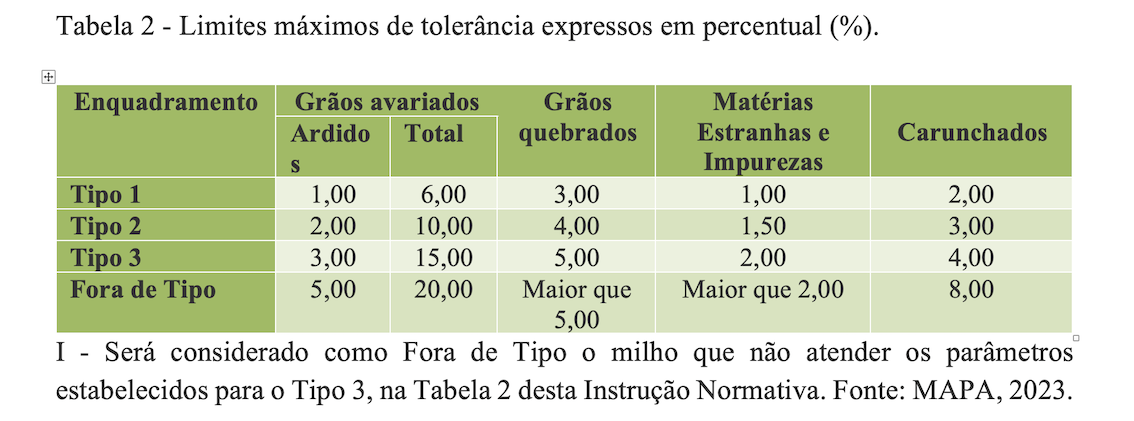
If rot levels in the field are low, the contaminated area can be harvested earlier and the contaminated grains separated from the healthy grains to avoid infection. Equipment, vehicles and machines can also spread fungal spores between contaminated and healthy grains, as fungal spores Aspergillus they come off easily and can accumulate at the bottom of them. If, already in the field, high infestation is observed, it is recommended that the incidence of mycotoxins be assessed.
Some factors are important for the infection and growth of aflatoxigenic fungi in stored grains, such as: temperature, water activity, pH, oxygen, in addition to physical factors such as injuries to the grains, which interfere with the growth and production of toxins by the fungi.
The highest levels of aflatoxin production are associated with corn stored in inadequate humidity and temperature conditions. Thus, post-harvest management strategies must be implemented to maintain adequate storage conditions. It is recommended to store the grains at a maximum of 13% humidity, in a clean, cool, ventilated and insect-free place. Furthermore, it is important to avoid high temperatures (above 20 °C) when storing and preserving seeds. If contaminated grains and silage (containing cobs) are above 15% moisture, the mycotoxin can continue to be produced. This is why it is important to maintain humidity at a maximum of 13%, the value at which fungi cease to develop. The ideal storage temperature varies between 16 and 18 °C, high values favor spoilage, reduce nutritional quality and increase the spread of fungi and insects. In addition to temperature and humidity, aeration must be adequate. In the presence of A. flavus It also causes rapid heating of the grains, requiring aeration, transilage, intrasilage and/or drying rectification.
Although natural methods are cost-effective, fungal contamination in grain is often unavoidable, so there is a need to apply a suitable process to inactivate the mycotoxin. It is part of the means of detoxifying already contaminated food, physical and chemical degradation. In physical degradation, solvent extraction, heat treatment and irradiation techniques (solar irradiation, gamma rays and ultraviolet light) can be used. Chemical methods consist of degrading or inactivating mycotoxins, using acids, bases, aldehydes, oxidizing agents and specific gases. The most accepted method on an industrial scale for the chemical degradation of aflatoxins is treatment with ammonia at relatively low pressure and temperature. Despite considerably reducing the levels of aflatoxins in food, chemical degradation can be ineffective or unsafe, in addition to reducing the nutritional levels and taste of the food. Therefore, prevention in the field remains the most viable alternative.
Mycotoxins in corn are a costly and challenging problem, but cultural and genetic approaches to their management are available. Cultural practices used in the field can be carried out in order to reduce the risk of contamination by mycotoxins. Genetic resistance and biological control are promising strategies for controlling aflatoxins. Furthermore, good practices in grain storage are essential tools in preventing the development of fungi and accumulation of aflatoxins after harvest.
To summarize, here are some recommendations for reducing ear rot and incidence of mycotoxins:
• Whenever possible, use cultivars that are less susceptible to fungi and the production of mycotoxins.
• Plant according to the recommendations of seed producing companies, avoiding climates for which the cultivar was not developed.
• Plant at the appropriate time, whenever weather conditions allow.
• Harvest at the appropriate time and humidity to maintain quality, avoiding grain breakage. If necessary, dry it, remembering that the ideal humidity for storage is 13%.
• Avoid keeping the ears in the field for an unnecessary period of time to avoid attacks by birds, insects, rain and the plants falling over.
• Carry out appropriate cultural treatments, ensuring good leaf health, balanced fertilization and stress.
• If possible, separate contaminated grains or ears from healthy ones.
• Fungicides are not recommended for controlling cob fungus.
• Ensure that storage conditions are adequate (temperatures between 16 and 18 °C associated with an ideal humidity of 13%) to maintain the quality of the grains and prevent the development of fungi and insect infestation.
• Carry out purges when the incidence of fungi and insects is higher.
Reducing ear rot and mycotoxins is a task that requires effort and commitment, however, everything possible must be done so that its damage is minimized, as the implications go beyond economic losses and can affect the most valuable thing we have, health. .
By Elaine Aparecida Guimarães, Biology Professor in the State of Minas Gerais; Dagma Dionísia da Silva Araújo, Luciano Viana Cota, Rodrigo Véras da Costa, Embrapa Corn and Sorghum; Fabrício Eustáquio Lanza, Cambuhy Agrícola Ltda
Receive the latest agriculture news by email



Receive the latest agriculture news by email


